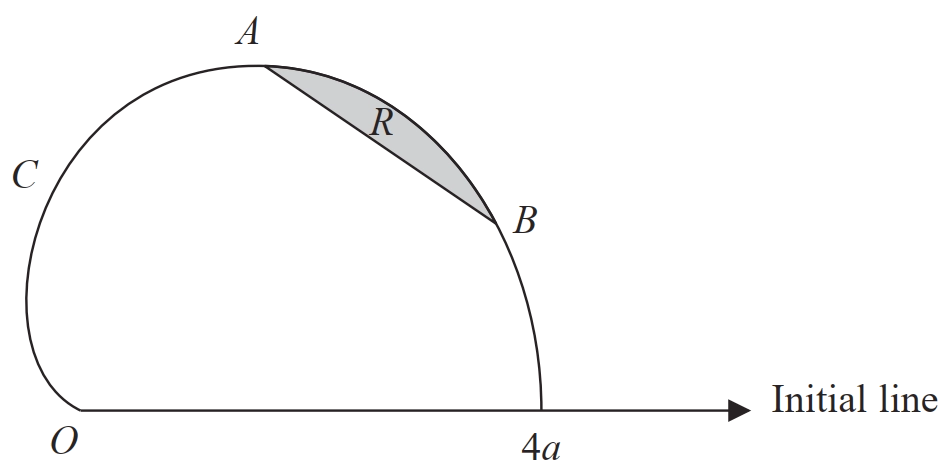
Figure 1 The curve C C C
r = 2 a ( 1 + cos θ ) 0 ⩽ θ ⩽ π \begin{align*}
r = 2a(1 + \cos\theta) \qquad 0 \leqslant \theta \leqslant \pi
\end{align*} r = 2 a ( 1 + cos θ ) 0 ⩽ θ ⩽ π where a a a
The tangent to C C C A A A
(a) Determine the polar coordinates of A A A
(6)
The point B B B ( a ( 2 + 3 ) , π 6 ) \left(a(2 + \sqrt{3}), \frac{\pi}{6}\right) ( a ( 2 + 3 ) , 6 π ) R R R C C C A B AB A B
(b) Use calculus to determine the exact area of the shaded region R R R
Give your answer in the form
a 2 4 ( d π − e + f 3 ) \begin{align*}
\frac{a^2}{4}\left(d\pi - e + f\sqrt{3}\right)
\end{align*} 4 a 2 ( d π − e + f 3 ) where d d d e e e f f f
(7)
解答
(a) The tangent is parallel to the initial line, so
d d θ ( r sin θ ) = 0 \begin{align*}
\frac{\mathrm{d}}{\mathrm{d}\theta}(r\sin\theta)=0
\end{align*} d θ d ( r sin θ ) = 0 Now
r sin θ = 2 a ( 1 + cos θ ) sin θ = 2 a sin θ + a sin 2 θ \begin{align*}
r\sin\theta
= &\,2a(1+\cos\theta)\sin\theta\\[4mm]
= &\,2a\sin\theta+ a\sin 2\theta
\end{align*} r sin θ = = 2 a ( 1 + cos θ ) sin θ 2 a sin θ + a sin 2 θ so
d d θ ( r sin θ ) = 2 a cos θ + 2 a cos 2 θ \begin{align*}
\frac{\mathrm{d}}{\mathrm{d}\theta}(r\sin\theta)
= &\,2a\cos\theta + 2a\cos 2\theta
\end{align*} d θ d ( r sin θ ) = 2 a cos θ + 2 a cos 2 θ Hence
2 cos θ + 2 cos 2 θ = 0 2 cos 2 θ + cos θ − 1 = 0 ( 2 cos θ − 1 ) ( cos θ + 1 ) = 0 \begin{align*}
2\cos\theta + 2\cos 2\theta
= &\,0\\[4mm]
2\cos 2\theta + \cos\theta - 1
= &\,0\\[4mm]
(2\cos\theta - 1)(\cos\theta + 1)
= &\,0
\end{align*} 2 cos θ + 2 cos 2 θ = 2 cos 2 θ + cos θ − 1 = ( 2 cos θ − 1 ) ( cos θ + 1 ) = 0 0 0 So θ = π / 3 \theta = \pi/3 θ = π /3
r = 2 a ( 1 + cos π 3 ) = 3 a \begin{align*}
r
= &\,2a\left(1+\cos\frac{\pi}{3}\right)\\[4mm]
= &\,3a
\end{align*} r = = 2 a ( 1 + cos 3 π ) 3 a Hence the polar coordinates of A A A ( 3 a , π 3 ) \left(3a,\frac{\pi}{3}\right) ( 3 a , 3 π )
(b) The area of the region between the curve and the initial line from θ = π / 3 \theta=\pi/3 θ = π /3 θ = π / 6 \theta=\pi/6 θ = π /6
1 2 ∫ π / 6 π / 3 ( 2 a ( 1 + cos θ ) ) 2 d θ = 2 a 2 ∫ π / 6 π / 3 ( 1 + 2 cos θ + cos 2 θ ) d θ = 2 a 2 ∫ π / 6 π / 3 ( 3 2 + 2 cos θ + 1 2 cos 2 θ ) d θ = 2 a 2 [ 3 θ 2 + 2 sin θ + 1 4 sin 2 θ ] π / 6 π / 3 \begin{align*}
&\,\frac{1}{2}\int_{\pi/6}^{\pi/3} \left(2a(1+\cos\theta)\right)^2 \,\mathrm{d}\theta\\[4mm]
= &\,2a^2\int_{\pi/6}^{\pi/3}(1+2\cos\theta+\cos^2\theta)\,\mathrm{d}\theta\\[4mm]
= &\,2a^2\int_{\pi/6}^{\pi/3}\left(\frac{3}{2}+2\cos\theta+\frac{1}{2}\cos 2\theta\right)\,\mathrm{d}\theta\\[4mm]
= &\,2a^2\left[\frac{3\theta}{2}+2\sin\theta+\frac{1}{4}\sin 2\theta\right]_{\pi/6}^{\pi/3}
\end{align*} = = = 2 1 ∫ π /6 π /3 ( 2 a ( 1 + cos θ ) ) 2 d θ 2 a 2 ∫ π /6 π /3 ( 1 + 2 cos θ + cos 2 θ ) d θ 2 a 2 ∫ π /6 π /3 ( 2 3 + 2 cos θ + 2 1 cos 2 θ ) d θ 2 a 2 [ 2 3 θ + 2 sin θ + 4 1 sin 2 θ ] π /6 π /3 This gives
area of curve region = 2 a 2 ( π 4 + 3 − 1 2 ) = a 2 4 ( 2 π + 10 ) \begin{align*}
\text{area of curve region}
= &\,2a^2\left(\frac{\pi}{4}+3-\frac{1}{2}\right)\\[4mm]
= &\,\frac{a^2}{4}\left(2\pi+10\right)
\end{align*} area of curve region = = 2 a 2 ( 4 π + 3 − 2 1 ) 4 a 2 ( 2 π + 10 ) The area of △ O A B \triangle OAB △ O A B
1 2 × 3 a × 2 a sin ( π 3 ) = 3 3 2 a 2 \begin{align*}
&\,\frac{1}{2}\times 3a \times 2a \sin\left(\frac{\pi}{3}\right)\\[4mm]
= &\,\frac{3\sqrt{3}}{2}a^2
\end{align*} = 2 1 × 3 a × 2 a sin ( 3 π ) 2 3 3 a 2 Therefore the shaded area is
a 2 4 ( 2 π + 10 ) − 3 3 2 a 2 = a 2 4 ( 2 π + 10 − 6 3 ) \begin{align*}
&\,\frac{a^2}{4}(2\pi+10)
- \frac{3\sqrt{3}}{2}a^2\\[4mm]
= &\,\frac{a^2}{4}\left(2\pi+10-6\sqrt{3}\right)
\end{align*} = 4 a 2 ( 2 π + 10 ) − 2 3 3 a 2 4 a 2 ( 2 π + 10 − 6 3 )