Skip to content
CalcGospel 國際數學圖譜
返回

IAL 2022 Jan Q3

A Level / Edexcel / FP2

IAL 2022 Jan Paper · Question 3

题目

Problem

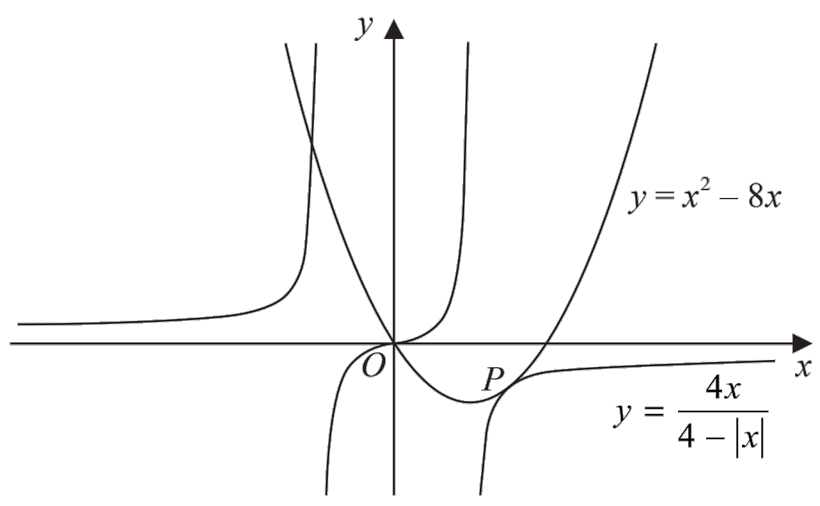
Figure 1

Figure 1 shows a sketch of the curve C1C_1 with equation

y=4x4x\begin{align*} y = \frac{4x}{4 - |x|} \end{align*}

and the curve C2C_2 with equation

y=x28x\begin{align*} y = x^2 - 8x \end{align*}

For x>0x > 0, C1C_1 has equation y=4x4xy = \frac{4x}{4 - x}

(a) Use algebra to show that C1C_1 touches C2C_2 at a point PP, stating the coordinates of PP.

(5)

(b) Hence or otherwise, using algebra, solve the inequality

x28x>4x4x\begin{align*} x^2 - 8x > \frac{4x}{4 - |x|} \end{align*}
(6)

解答

(a)

解法一

思路

展开

题目已经说明当 x>0x>0 时,

C1:y=4x4x.\begin{align*} C_1:\quad y=\frac{4x}{4-x}. \end{align*}

令两条曲线相交,解方程。如果得到 repeated root,就说明它们在该点相切。

答题过程

展开

For x>0x>0,

C1:y=4x4x.\begin{align*} C_1:\quad y=\frac{4x}{4-x}. \end{align*}

At an intersection with C2C_2,

x28x=4x4x.\begin{align*} x^2-8x=\frac{4x}{4-x}. \end{align*}

Multiply by 4x4-x:

(x28x)(4x)=4x.\begin{align*} (x^2-8x)(4-x)=4x. \end{align*}

Expand the left hand side:

(x28x)(4x)=4x232xx3+8x2=x3+12x232x.\begin{align*} (x^2-8x)(4-x) =&\,4x^2-32x-x^3+8x^2\\[2mm] =&\,-x^3+12x^2-32x. \end{align*}

So

x3+12x232x=4x.\begin{align*} -x^3+12x^2-32x=4x. \end{align*}

Bring all terms to one side:

x3+12x236x=0.\begin{align*} -x^3+12x^2-36x=0. \end{align*}

Factorise:

x(x212x+36)=0.\begin{align*} -x(x^2-12x+36)=0. \end{align*}

So

x=0or(x6)2=0.\begin{align*} x=0 \quad\text{or}\quad (x-6)^2=0. \end{align*}

For the point of contact on the positive branch,

x=6.\begin{align*} x=6. \end{align*}

Then

y=628(6)=3648=12.\begin{align*} y=6^2-8(6)=36-48=-12. \end{align*}

Since x=6x=6 is a repeated root, the curves touch at

P=(6,12).\begin{align*} P=(6,-12). \end{align*}

解法二

思路

展开

也可以比较两条曲线的 gradient。若它们在同一点相交且 gradient 相同,就说明它们相切。

答题过程

展开

For x>0x>0,

C1:y=4x4x.\begin{align*} C_1:\quad y=\frac{4x}{4-x}. \end{align*}

Differentiate C1C_1:

ddx(4x4x)=4(4x)4x(1)(4x)2=16(4x)2.\begin{align*} \frac{\mathrm{d}}{\mathrm{d}x} \left(\frac{4x}{4-x}\right) =&\,\frac{4(4-x)-4x(-1)} {(4-x)^2}\\[2mm] =&\,\frac{16}{(4-x)^2}. \end{align*}

For C2C_2,

y=x28x,\begin{align*} y=x^2-8x, \end{align*}

so

dydx=2x8.\begin{align*} \frac{\mathrm{d}y}{\mathrm{d}x}=2x-8. \end{align*}

At a point of tangency,

2x8=16(4x)2.\begin{align*} 2x-8=\frac{16}{(4-x)^2}. \end{align*}

This is satisfied by x=6x=6, since

2(6)8=4\begin{align*} 2(6)-8=4 \end{align*}

and

16(46)2=4.\begin{align*} \frac{16}{(4-6)^2}=4. \end{align*}

At x=6x=6,

x28x=12,\begin{align*} x^2-8x=-12, \end{align*}

and

4x4x=242=12.\begin{align*} \frac{4x}{4-x} =&\,\frac{24}{-2}\\[2mm] =&\,-12. \end{align*}

So the curves meet with the same gradient at

P=(6,12).\begin{align*} P=(6,-12). \end{align*}

(b)

解法一

思路

展开

因为有 x|x|,要分成 x>0x>0x<0x<0 两个分支。

x>0x>0 时,右边是 4x4x\dfrac{4x}{4-x},而 (a) 已经告诉我们 x=6x=6 是相切点。还要注意 x=4x=4 是 vertical asymptote。

x<0x<0 时,右边是 4x4+x\dfrac{4x}{4+x},需要另外求交点。

答题过程

展开

We solve

x28x>4x4x.\begin{align*} x^2-8x>\frac{4x}{4-|x|}. \end{align*}

First consider x>0x>0. Then x=x|x|=x, so

x28x>4x4x.\begin{align*} x^2-8x>\frac{4x}{4-x}. \end{align*}

From part (a), the curves touch at x=6x=6. Also, this branch has a vertical asymptote at

x=4.\begin{align*} x=4. \end{align*}

Testing the intervals 0<x<40<x<4, 4<x<64<x<6, and x>6x>6 gives

4<x<6orx>6.\begin{align*} 4<x<6 \quad\text{or}\quad x>6. \end{align*}

Now consider x<0x<0. Then x=x|x|=-x, so

x28x>4x4+x.\begin{align*} x^2-8x>\frac{4x}{4+x}. \end{align*}

Find the intersections:

x28x=4x4+x.\begin{align*} x^2-8x=\frac{4x}{4+x}. \end{align*}

Multiply by 4+x4+x:

(x28x)(4+x)=4x.\begin{align*} (x^2-8x)(4+x)=4x. \end{align*}

Expand:

4x2+x332x8x2=4x.\begin{align*} 4x^2+x^3-32x-8x^2=4x. \end{align*}

So

x34x236x=0.\begin{align*} x^3-4x^2-36x=0. \end{align*}

Factorise:

x(x24x36)=0.\begin{align*} x(x^2-4x-36)=0. \end{align*}

Thus

x=0orx=2±210.\begin{align*} x=0 \quad\text{or}\quad x=2\pm2\sqrt{10}. \end{align*}

For x<0x<0, the relevant intersection is

x=2210.\begin{align*} x=2-2\sqrt{10}. \end{align*}

This branch also has a vertical asymptote at

x=4.\begin{align*} x=-4. \end{align*}

Testing intervals on the negative side gives

x<2210or4<x<0.\begin{align*} x<2-2\sqrt{10} \quad\text{or}\quad -4<x<0. \end{align*}

Combining the positive and negative branches, the solution is

x<2210,4<x<0,4<x<6,x>6.\begin{align*} x<2-2\sqrt{10}, \qquad -4<x<0, \qquad 4<x<6, \qquad x>6. \end{align*}