Skip to content
CalcGospel 國際數學圖譜
返回

IAL 2022 Jan Q4

A Level / Edexcel / FP2

IAL 2022 Jan Paper · Question 4

题目

Problem

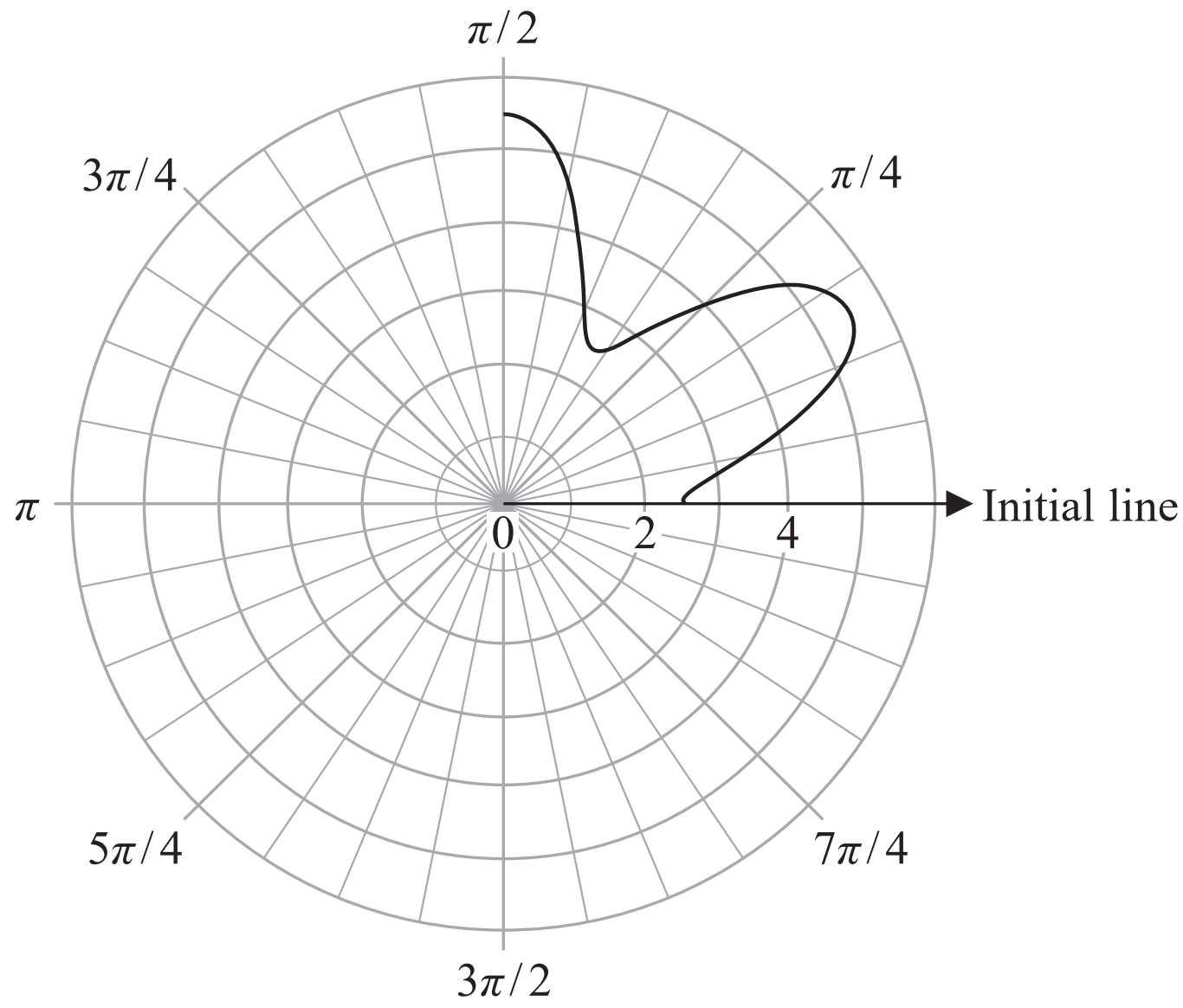
Figure 2

Figure 2 shows part of the curve with polar equation

r=432cos6θ0θ<2π\begin{align*} r = 4 - \frac{3}{2} \cos 6\theta \qquad 0 \leqslant \theta < 2\pi \end{align*}

(a) Sketch, on the polar grid in Figure 2,

(i) the rest of the curve with equation r=432cos6θ0θ<2π\quad r = 4 - \frac{3}{2} \cos 6\theta \qquad 0 \leqslant \theta < 2\pi

(ii) the polar curve with equation r=10θ<2π\quad r = 1 \qquad 0 \leqslant \theta < 2\pi

A spare copy of the grid is given on page 15.
(3)
In part (b) you must show all stages of your working.
Solutions relying entirely on calculator technology are not acceptable.

(b) Determine the exact area enclosed between the two curves defined in part (a).

(7)

解答

(a)

解法一

思路

展开

cos6θ\cos6\theta 的周期是 π3\dfrac{\pi}{3},所以整个曲线有 66 个重复的波瓣。最大半径出现在 cos6θ=1\cos6\theta=-1 时:

r=4+32=112.\begin{align*} r=4+\frac32=\frac{11}{2}. \end{align*}

最小半径出现在 cos6θ=1\cos6\theta=1 时:

r=432=52.\begin{align*} r=4-\frac32=\frac52. \end{align*}

r=1r=1 是以 pole 为圆心、半径为 11 的圆。

答题过程

展开

The curve

r=432cos6θ\begin{align*} r=4-\frac32\cos6\theta \end{align*}

has period

2π6=π3.\begin{align*} \frac{2\pi}{6}=\frac{\pi}{3}. \end{align*}

So the full curve has 66 repeated petals.

Its minimum radius is

432=52,\begin{align*} 4-\frac32=\frac52, \end{align*}

and its maximum radius is

4+32=112.\begin{align*} 4+\frac32=\frac{11}{2}. \end{align*}

The curve r=1r=1 is a circle centred at the pole with radius 11.

(b)

解法一

思路

展开

因为

432cos6θ\begin{align*} 4-\frac32\cos6\theta \end{align*}

的最小值是 52\dfrac52,所以外面的 polar curve 始终在圆 r=1r=1 外面。所求面积就是外曲线包围面积减去圆面积。

答题过程

展开

The area enclosed by the outer polar curve is

Aouter=1202π(432cos6θ)2dθ.\begin{align*} A_{\text{outer}} =&\,\frac12\int_0^{2\pi} \left(4-\frac32\cos6\theta\right)^2 \,\mathrm{d}\theta. \end{align*}

Expand the square:

(432cos6θ)2=1612cos6θ+94cos26θ.\begin{align*} \left(4-\frac32\cos6\theta\right)^2 =&\,16-12\cos6\theta +\frac94\cos^26\theta. \end{align*}

Use

cos26θ=12(1+cos12θ).\begin{align*} \cos^26\theta=\frac12(1+\cos12\theta). \end{align*}

Then

Aouter=1202π[1612cos6θ+98(1+cos12θ)]dθ.\begin{align*} A_{\text{outer}} =&\,\frac12\int_0^{2\pi} \left[ 16-12\cos6\theta +\frac98(1+\cos12\theta) \right]\,\mathrm{d}\theta. \end{align*}

Integrate:

Aouter=12[16θ2sin6θ+98θ+332sin12θ]02π.\begin{align*} A_{\text{outer}} =&\,\frac12 \left[ 16\theta-2\sin6\theta +\frac98\theta+\frac{3}{32}\sin12\theta \right]_0^{2\pi}. \end{align*}

At both limits, the sine terms are zero. Therefore

Aouter=12[16(2π)+98(2π)]=12(32π+9π4)=137π8.\begin{align*} A_{\text{outer}} =&\,\frac12 \left[ 16(2\pi)+\frac98(2\pi) \right]\\[2mm] =&\,\frac12 \left(32\pi+\frac{9\pi}{4}\right)\\[2mm] =&\,\frac{137\pi}{8}. \end{align*}

The inner curve is the circle

r=1,\begin{align*} r=1, \end{align*}

so its area is

π.\begin{align*} \pi. \end{align*}

Hence the area enclosed between the two curves is

137π8π=137π88π8=129π8.\begin{align*} \frac{137\pi}{8}-\pi =&\,\frac{137\pi}{8}-\frac{8\pi}{8}\\[2mm] =&\,\frac{129\pi}{8}. \end{align*}