题目
Problem
A complex number z is represented by the point P in an Argand diagram.
Given that
∣z−2i∣=∣z−3∣
(a) sketch the locus of P. You do not need to find the coordinates of any intercepts.
(2)
The transformation T from the z-plane to the w-plane is given by
w=z−2iizz=2i
Given that T maps ∣z−2i∣=∣z−3∣ to a circle C in the w-plane,
(b) find the equation of C, giving your answer in the form
∣w−(p+qi)∣=r
where p, q and r are real numbers to be determined.
(6)
解答
(a)
解法一
思路
展开
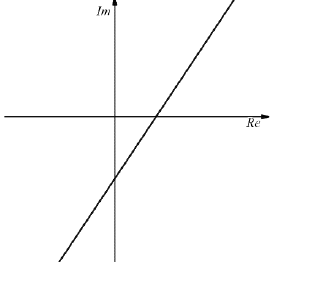
∣z−2i∣=∣z−3∣ 表示点 P 到 2i 和 3 的距离相等,所以轨迹是连接 (0,2) 与 (3,0) 线段的垂直平分线。
答题过程
展开
The equation
∣z−2i∣=∣z−3∣
means that P is equidistant from the points representing 2i and 3.
So the locus is the perpendicular bisector of the line segment joining
(0,2)and(3,0).
The sketch should be a straight line with positive gradient, not passing through the origin, lying through quadrants I, III and IV.
(b)
解法一
思路
展开
把 z 用 w 表示,再直接代入原来的模长关系。这样可以避免先求直线方程再代入,整体更短。
答题过程
展开
Given
w=z−2iiz.
Rearrange:
w(z−2i)=wz−2iw=z(w−i)=z=iziz2iww−i2iw.
The original locus is
∣z−2i∣=∣z−3∣.
Substitute z=w−i2iw:
w−i2iw−2i=w−i2iw−3.
Since w=i, multiply both sides by ∣w−i∣:
∣2iw−2i(w−i)∣=∣−2∣=∣2iw−3(w−i)∣∣(2i−3)w+3i∣.
So
2==∣(2i−3)w+3i∣∣2i−3∣w+2i−33i.
Now
∣2i−3∣=13.
Also,
2i−33i===(2i−3)(−3−2i)3i(−3−2i)13−9i−6i2136−9i.
Therefore
2=13w+136−139i.
Hence
w−(−136+139i)==13213213.
So
w−(−136+139i)=13213.