Skip to content
CalcGospel 國際數學圖譜
返回

IAL 2023 June Q8

A Level / Edexcel / FP2

IAL 2023 June Paper · Question 8

题目

Problem

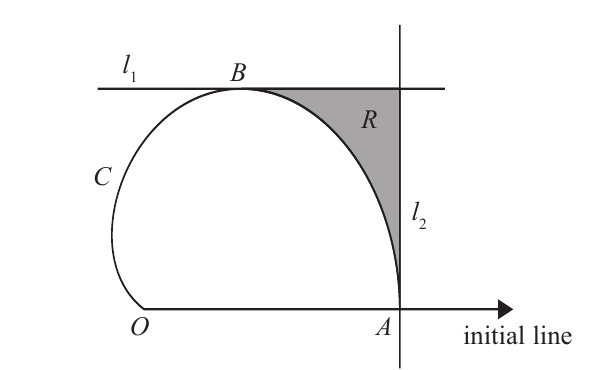
Figure 1

Figure 1 shows a sketch of the curve CC with equation

r=6(1+cosθ)0θπ\begin{align*} r ={}& 6(1 + \cos \theta) \qquad 0 \leqslant \theta \leqslant \pi \end{align*}

Given that CC meets the initial line at the point AA , as shown in Figure 1,

(a) write down the polar coordinates of AA .

(1)

The line l1l_1 also shown in Figure 1, is the tangent to CC at the point BB and is parallel to the initial line.

(b) Use calculus to determine the polar coordinates of BB .

(4)

The line l2l_2 also shown in Figure 1, is the tangent to CC at AA and is perpendicular to the initial line.

The region RR , shown shaded in Figure 1, is bounded by CC , l1l_1 and l2l_2 .

(c) Use algebraic integration to find the exact area of RR , giving your answer in the form p3+qπp\sqrt{3} + q\pi where pp and qq are constants to be determined.

(8)

解答

(a)

解法一

思路

展开

初始线对应 θ=0\theta=0。把 θ=0\theta=0 代入极坐标方程即可。

答题过程

展开

At the initial line, θ=0\theta=0. Therefore

r=6(1+cos0)=6(1+1)=12\begin{align*} r ={}& 6(1+\cos0)\\[4mm] ={}& 6(1+1)\\[4mm] ={}& 12 \end{align*}

So the polar coordinates of AA are

(12,0)\begin{align*} \boxed{(12,0)} \end{align*}

(b)

解法一

思路

展开

切线平行于 initial line,也就是水平切线。极坐标中 y=rsinθy=r\sin\theta,水平切线需要 dydθ=0\frac{\mathrm{d}y}{\mathrm{d}\theta}=0

答题过程

展开

Since the tangent at BB is parallel to the initial line,

dydθ=0\begin{align*} \frac{\mathrm{d}y}{\mathrm{d}\theta}=0 \end{align*}

Now

y=rsinθ=6(1+cosθ)sinθ=6sinθ+6sinθcosθ=6sinθ+3sin2θ\begin{align*} y ={}& r\sin\theta\\[4mm] ={}& 6(1+\cos\theta)\sin\theta\\[4mm] ={}& 6\sin\theta+6\sin\theta\cos\theta\\[4mm] ={}& 6\sin\theta+3\sin2\theta \end{align*}

Differentiate:

dydθ=6cosθ+6cos2θ\begin{align*} \frac{\mathrm{d}y}{\mathrm{d}\theta} ={}& 6\cos\theta+6\cos2\theta \end{align*}

Set this equal to zero:

6cosθ+6cos2θ=0cosθ+cos2θ=0cosθ+(2cos2θ1)=02cos2θ+cosθ1=0(2cosθ1)(cosθ+1)=0\begin{align*} 6\cos\theta+6\cos2\theta ={}&0\\[4mm] \cos\theta+\cos2\theta ={}&0\\[4mm] \cos\theta+(2\cos^2\theta-1) ={}&0\\[4mm] 2\cos^2\theta+\cos\theta-1 ={}&0\\[4mm] (2\cos\theta-1)(\cos\theta+1) ={}&0 \end{align*}

So

cosθ=12orcosθ=1\begin{align*} \cos\theta=\frac12 \quad\text{or}\quad \cos\theta=-1 \end{align*}

The point BB is the horizontal tangent above the initial line, so

θ=π3\begin{align*} \theta=\frac{\pi}{3} \end{align*}

Then

r=6(1+cosπ3)=6(1+12)=9\begin{align*} r ={}& 6\left(1+\cos\frac{\pi}{3}\right)\\[4mm] ={}& 6\left(1+\frac12\right)\\[4mm] ={}& 9 \end{align*}

Therefore

B=(9,π3)\begin{align*} \boxed{B=\left(9,\frac{\pi}{3}\right)} \end{align*}

(c)

解法一

思路

展开

阴影区域可以看作外面的梯形 OAPBOAPB 减去曲线从 θ=0\theta=0θ=π3\theta=\frac{\pi}{3} 扫出的极坐标面积。这里 PP 是两条切线的交点。题目要求 algebraic integration,所以极坐标面积要完整积分。

答题过程

展开

From part (b),

B=(9,π3)\begin{align*} B=\left(9,\frac{\pi}{3}\right) \end{align*}

The Cartesian coordinates of BB are

xB=9cosπ3=92yB=9sinπ3=932\begin{align*} x_B ={}& 9\cos\frac{\pi}{3} =\frac92\\[4mm] y_B ={}& 9\sin\frac{\pi}{3} =\frac{9\sqrt3}{2} \end{align*}

The tangent l1l_1 is horizontal, so

l1:y=932\begin{align*} l_1:\quad y=\frac{9\sqrt3}{2} \end{align*}

The tangent l2l_2 at AA is vertical, so

l2:x=12\begin{align*} l_2:\quad x=12 \end{align*}

Hence the intersection PP of the two tangents is

P=(12,932)\begin{align*} P=\left(12,\frac{9\sqrt3}{2}\right) \end{align*}

The top horizontal length is

BP=1292=152\begin{align*} BP ={}& 12-\frac92\\[4mm] ={}& \frac{15}{2} \end{align*}

So the area of trapezium OAPBOAPB is

AreaOAPB=12(12+152)(932)=12392932=35138\begin{align*} \text{Area}_{OAPB} ={}& \frac12 \left(12+\frac{15}{2}\right) \left(\frac{9\sqrt3}{2}\right)\\[4mm] ={}& \frac12\cdot\frac{39}{2}\cdot\frac{9\sqrt3}{2}\\[4mm] ={}& \frac{351\sqrt3}{8} \end{align*}

Now find the polar area under CC from θ=0\theta=0 to θ=π3\theta=\frac{\pi}{3}:

Areasector=120π3r2dθ=120π336(1+cosθ)2dθ=180π3(1+2cosθ+cos2θ)dθ=180π3(1+2cosθ+1+cos2θ2)dθ=180π3(32+2cosθ+12cos2θ)dθ\begin{align*} \text{Area}_{\text{sector}} ={}& \frac12\int_0^{\frac{\pi}{3}} r^2\,\mathrm{d}\theta\\[4mm] ={}& \frac12\int_0^{\frac{\pi}{3}} 36(1+\cos\theta)^2\,\mathrm{d}\theta\\[4mm] ={}& 18\int_0^{\frac{\pi}{3}} (1+2\cos\theta+\cos^2\theta)\,\mathrm{d}\theta\\[4mm] ={}& 18\int_0^{\frac{\pi}{3}} \left(1+2\cos\theta+\frac{1+\cos2\theta}{2}\right) \,\mathrm{d}\theta\\[4mm] ={}& 18\int_0^{\frac{\pi}{3}} \left(\frac32+2\cos\theta+\frac12\cos2\theta\right) \,\mathrm{d}\theta \end{align*}

Integrating,

Areasector=18[32θ+2sinθ+14sin2θ]0π3=18(π2+232+1432)=18(π2+3+38)=18(π2+938)=9π+8134\begin{align*} \text{Area}_{\text{sector}} ={}& 18\left[ \frac32\theta+2\sin\theta+\frac14\sin2\theta \right]_0^{\frac{\pi}{3}}\\[4mm] ={}& 18\left( \frac{\pi}{2} +2\cdot\frac{\sqrt3}{2} +\frac14\cdot\frac{\sqrt3}{2} \right)\\[4mm] ={}& 18\left( \frac{\pi}{2} +\sqrt3 +\frac{\sqrt3}{8} \right)\\[4mm] ={}& 18\left( \frac{\pi}{2} +\frac{9\sqrt3}{8} \right)\\[4mm] ={}& 9\pi+\frac{81\sqrt3}{4} \end{align*}

Therefore the required area is

AreaR=AreaOAPBAreasector=35138(9π+8134)=351389π16238=189389π\begin{align*} \text{Area}_R ={}& \text{Area}_{OAPB}-\text{Area}_{\text{sector}}\\[4mm] ={}& \frac{351\sqrt3}{8} -\left(9\pi+\frac{81\sqrt3}{4}\right)\\[4mm] ={}& \frac{351\sqrt3}{8} -9\pi-\frac{162\sqrt3}{8}\\[4mm] ={}& \boxed{\frac{189\sqrt3}{8}-9\pi} \end{align*}

Thus

p=1898,q=9\begin{align*} p=\frac{189}{8},\qquad q=-9 \end{align*}