Skip to content
CalcGospel 國際數學圖譜
返回

IAL 2024 Jan Q7

A Level / Edexcel / FP2

IAL 2024 Jan Paper · Question 7

题目

Problem

A transformation TT from the zz-plane, where z=x+iyz = x + iy , to the ww-plane, where w=u+ivw = u + iv is given by

w=z32izz2i\begin{align*} w ={}& \frac{z - 3}{2\mathrm{i} - z} \qquad z \neq 2\mathrm{i} \end{align*}

The line in the zz-plane with equation y=x+3y = x + 3 is mapped by TT onto a circle CC in the ww-plane.

(a) Determine

(i) the coordinates of the centre of CC

(ii) the exact radius of CC

(8)

The region y>x+3y > x + 3 in the zz-plane is mapped by TT onto the region RR in the ww-plane.

(b) On a single Argand diagram

(i) sketch the circle CC

(ii) shade and label the region RR

(2)

解答

(a)

解法一

思路

展开

要求 ww-plane 里的圆,可以先把 zzww 表示,再令 w=u+ivw=u+\mathrm{i}v。然后把得到的 x,yx,y 代入直线 y=x+3y=x+3,化成圆方程。

答题过程

展开

From

w=z32iz,\begin{align*} w=\frac{z-3}{2\mathrm{i}-z}, \end{align*}

make zz the subject:

w(2iz)=z32iwwz=z3z(w+1)=3+2iwz=3+2iww+1\begin{align*} w(2\mathrm{i}-z)={}&z-3\\[2mm] 2\mathrm{i}w-wz={}&z-3\\[2mm] z(w+1)={}&3+2\mathrm{i}w\\[2mm] z={}&\frac{3+2\mathrm{i}w}{w+1} \end{align*}

Put w=u+ivw=u+\mathrm{i}v:

z=3+2i(u+iv)u+iv+1=(32v)+2iu(u+1)+iv\begin{align*} z ={}& \frac{3+2\mathrm{i}(u+\mathrm{i}v)}{u+\mathrm{i}v+1}\\[4mm] ={}& \frac{(3-2v)+2\mathrm{i}u}{(u+1)+\mathrm{i}v} \end{align*}

Rationalise the denominator:

z=((32v)+2iu)((u+1)iv)(u+1)2+v2\begin{align*} z ={}& \frac{((3-2v)+2\mathrm{i}u)((u+1)-\mathrm{i}v)} {(u+1)^2+v^2} \end{align*}

Expand the numerator:

((32v)+2iu)((u+1)iv)=(32v)(u+1)+2uv+i(2u(u+1)v(32v))\begin{align*} ((3-2v)+2\mathrm{i}u)((u+1)-\mathrm{i}v) ={}& (3-2v)(u+1)+2uv\\[2mm] &\,\hspace{2pt}+\mathrm{i}\left(2u(u+1)-v(3-2v)\right) \end{align*}

Since z=x+iyz=x+\mathrm{i}y,

x=(32v)(u+1)+2uv(u+1)2+v2y=2u(u+1)v(32v)(u+1)2+v2\begin{align*} x={}& \frac{(3-2v)(u+1)+2uv}{(u+1)^2+v^2}\\[4mm] y={}& \frac{2u(u+1)-v(3-2v)}{(u+1)^2+v^2} \end{align*}

Use y=x+3y=x+3:

2u(u+1)v(32v)(u+1)2+v2=(32v)(u+1)+2uv(u+1)2+v2+3\begin{align*} \frac{2u(u+1)-v(3-2v)} {(u+1)^2+v^2} ={}& \frac{(3-2v)(u+1)+2uv} {(u+1)^2+v^2} +3 \end{align*}

Multiplying by the denominator and expanding gives

2u2+2u3v+2v2=3u2v+3+3(u+1)2+3v22u2+2u3v+2v2=3u2v+3+3u2+6u+3+3v2\begin{align*} 2u^2+2u-3v+2v^2 ={}& 3u-2v+3+3(u+1)^2+3v^2\\[4mm] 2u^2+2u-3v+2v^2 ={}& 3u-2v+3+3u^2+6u+3+3v^2 \end{align*}

Therefore

u2+v2+7u+v+6=0\begin{align*} u^2+v^2+7u+v+6=0 \end{align*}

Complete the square:

(u+72)2494+(v+12)214+6=0(u+72)2+(v+12)2=494+146=132\begin{align*} \left(u+\frac72\right)^2-\frac{49}{4} +\left(v+\frac12\right)^2-\frac14+6 ={}&0\\[4mm] \left(u+\frac72\right)^2 +\left(v+\frac12\right)^2 ={}& \frac{49}{4}+\frac14-6\\[4mm] ={}& \frac{13}{2} \end{align*}

Hence the centre is

(72,12)\begin{align*} \boxed{\left(-\frac72,-\frac12\right)} \end{align*}

and the radius is

132=262\begin{align*} \boxed{\sqrt{\frac{13}{2}}=\frac{\sqrt{26}}{2}} \end{align*}

解法二

思路

展开

另一种方法是直接把直线写成 z=x+i(x+3)z=x+\mathrm{i}(x+3),代入变换式,得到 u,vu,v 与参数 xx 的关系,再消去 xx

答题过程

展开

On the line y=x+3y=x+3,

z=x+i(x+3)\begin{align*} z=x+\mathrm{i}(x+3) \end{align*}

Substitute into the transformation:

w=x+i(x+3)32ixi(x+3)=x3+i(x+3)xi(x+1)\begin{align*} w ={}& \frac{x+\mathrm{i}(x+3)-3} {2\mathrm{i}-x-\mathrm{i}(x+3)}\\[4mm] ={}& \frac{x-3+\mathrm{i}(x+3)} {-x-\mathrm{i}(x+1)} \end{align*}

Let w=u+ivw=u+\mathrm{i}v and cross-multiply:

(u+iv)(xi(x+1))=x3+i(x+3)\begin{align*} (u+\mathrm{i}v)(-x-\mathrm{i}(x+1)) ={}& x-3+\mathrm{i}(x+3) \end{align*}

Equating real and imaginary parts gives

ux+v(x+1)=x3u(x+1)vx=x+3\begin{align*} -ux+v(x+1)={}&x-3\\[2mm] -u(x+1)-vx={}&x+3 \end{align*}

Make xx the subject from each equation:

x=3+v1+uvx=3u1+u+v\begin{align*} x={}&\frac{3+v}{1+u-v}\\[2mm] x={}&\frac{-3-u}{1+u+v} \end{align*}

Equate these expressions:

3+v1+uv=3u1+u+v(3+v)(1+u+v)=(3u)(1+uv)\begin{align*} \frac{3+v}{1+u-v} ={}& \frac{-3-u}{1+u+v}\\[4mm] (3+v)(1+u+v) ={}& (-3-u)(1+u-v) \end{align*}

Expanding and simplifying:

3+3u+4v+uv+v2=34uu2+3v+uvu2+v2+7u+v+6=0\begin{align*} 3+3u+4v+uv+v^2 ={}& -3-4u-u^2+3v+uv\\[4mm] u^2+v^2+7u+v+6 ={}&0 \end{align*}

So, as in 解法一,

(u+72)2+(v+12)2=132\begin{align*} \left(u+\frac72\right)^2 +\left(v+\frac12\right)^2 ={}& \frac{13}{2} \end{align*}

Therefore the centre is

(72,12)\begin{align*} \boxed{\left(-\frac72,-\frac12\right)} \end{align*}

and the radius is

262\begin{align*} \boxed{\frac{\sqrt{26}}{2}} \end{align*}

(b)

解法一

思路

展开

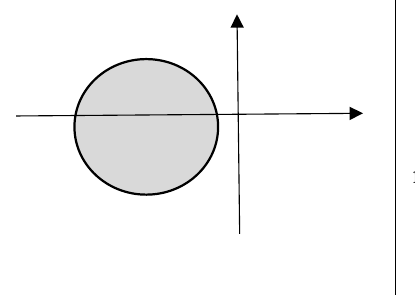
圆心是 (72,12)\left(-\frac72,-\frac12\right),半径约为 2.552.55,所以圆整体在第二、第三象限。区域 y>x+3y>x+3 对应圆的内部;可以用一个位于直线上方的点测试来判断阴影侧。

答题过程

展开

On the Argand diagram:

  • sketch the circle
(u+72)2+(v+12)2=132;\begin{align*} \left(u+\frac72\right)^2 +\left(v+\frac12\right)^2 ={}& \frac{13}{2}; \end{align*}
  • mark its centre at (72,12)\left(-\frac72,-\frac12\right);
  • shade the inside of the circle and label it RR.

The circle should lie in quadrants II and III, with most of it in quadrant III.