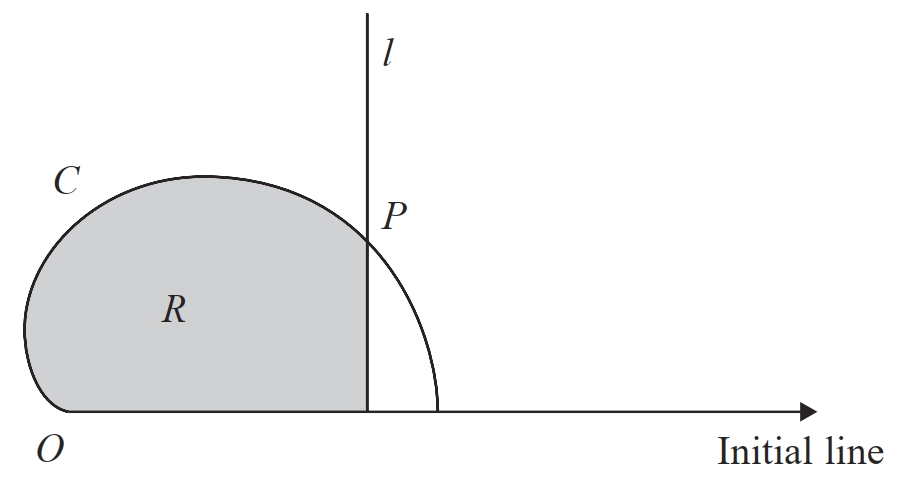
Figure 1 shows a sketch of the curve C with polar equation
r=1+cosθ0⩽θ⩽π
and the line l with polar equation
r=ksecθ0⩽θ<2π
where k is a positive constant.
Given that
C and l intersect at the point P
OP=1+23
(a) determine the exact value of k.
(2)
The finite region R , shown shaded in Figure 1, is bounded by C , the initial line and l .
(b) Use algebraic integration to show that the area of R is
pπ+q3+r
where p , q and r are simplified rational numbers to be determined.
(7)
解答
(a)
The curve C is given by r=1+cosθ and the line l is r=ksecθ.
They intersect at point P where OP=r=1+23.
First, find the angle θ at P using the equation for curve C:
1+cosθ=cosθ=θ=1+23236π
Since P also lies on the line l, substitute r and θ into the line’s polar equation:
r=rcosθ=(1+23)(23)=k=ksecθkk23+43
(b)
The region R is bounded by C from θ=6π to θ=π, and by a triangle formed by the pole, the line l (which is a vertical line x=k), and the line segment OP.
The area of region R can be found by adding the area under C between 6π and π to the area of the right-angled triangle formed between θ=0 and θ=6π up to the line x=k.
Area of this sector =43π−(8π+21+163)=85π−21−163.
Area of the Triangle:
The triangle has a base along the initial line of length k=23+43, and a height yP at point P.
We can use the formula Area =21absinC, where a=ksec(π/6) (the distance OP), and b=k, but it’s simpler to use the Cartesian area of a right triangle 21xy:
xP=yP=rcos(6π)=k=423+3rsin(6π)=(1+23)(21)=42+3Area of Triangle=====21xPyP21(423+3)(42+3)321(43+6+6+33)3212+7383+3273
Total Area of R:
Total Area===(85π−21−163)+(83+3273)85π−84+83−3223+327385π+3253−81
This is in the required form pπ+q3+r, with p=85, q=325, and r=−81.