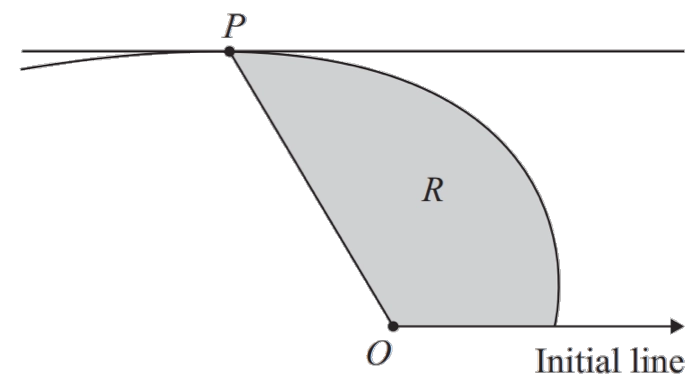
Figure 1
In this question you must show all stages of your working.
Solutions relying entirely on calculator technology are not acceptable.
Figure 1 shows a sketch of part of the curve with polar equation
r=3+tan2θ0⩽θ<π
The tangent to the curve at the point P is parallel to the initial line.
(a) Using the identity tan2θ=sinθ1−cosθ or otherwise, determine the exact value of θ at P.
(4)
The region R , shown shaded in Figure 1, is bounded by the initial line, the curve and the line OP , where O is the pole.
(b) Use algebraic integration to determine the exact area of R , giving your answer in the form pln2+qπ+r where p , q and r are constants.
(6)
解答
(a)
Since the tangent is parallel to the initial line, dθdy=0, where y=rsinθ.
y====rsinθ(3+tan2θ)sinθ(3+sinθ1−cosθ)sinθ3sinθ+1−cosθ
Differentiating with respect to θ:
dθdy=3cosθ+sinθ
Setting dθdy=0:
3cosθ+sinθ=sinθ=tanθ=0−3cosθ−3
Given the domain 0⩽θ<π, the only solution is:
θ==π−3π32π
(b)
The area of the shaded region R is given by 21∫r2dθ.
∫r2dθ=====∫(3+tan2θ)2dθ∫(3+23tan2θ+tan22θ)dθ∫(3+23tan2θ+sec22θ−1)dθ∫(2+23tan2θ+sec22θ)dθ2θ−43ln(cos2θ)+2tan2θ
Evaluating from θ=0 to θ=32π:
Area=====21[2θ−43ln(cos2θ)+2tan2θ]032π21((2(32π)−43ln(cos3π)+2tan3π)−(0−43ln1+0))21(34π−43ln(21)+23)21(34π+43ln2+23)23ln2+32π+3