
Skip to content
CalcGospel 國際數學圖譜
返回

IAL 2025 June A Q6

A Level / Edexcel / FP2

IAL 2025 June A Paper · Question 6

题目

Problem

In this question you must show all stages of your working.
Solutions relying entirely on calculator technology are not acceptable.

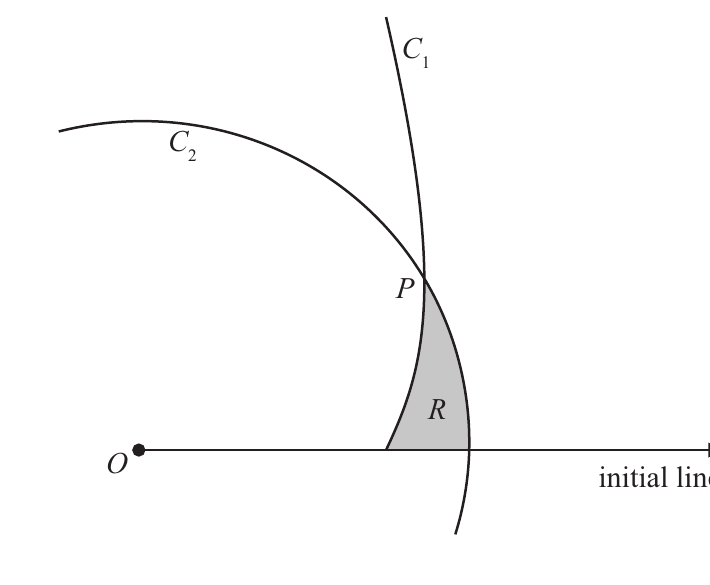
Figure 3

The curve C1C_1 has equation

r=3+tanθ0<θ<π2\begin{align*} r=\sqrt3+\tan\theta\qquad 0<\theta<\frac{\pi}{2} \end{align*}

The tangent to C1C_1 is perpendicular to the initial line at the point PP

(a) Use calculus to determine, in simplest form, the exact polar coordinates of PP

(4)

Figure 3 shows a sketch of part of the curve C1C_1 and part of the curve C2C_2

The curve C2C_2 is a circle with centre at the pole OO.

The curves C1C_1 and C2C_2 intersect at PP.

The region RR, shown shaded in Figure 3, is bounded by C1C_1, C2C_2 and the initial line.

(b) Use algebraic integration to determine the area of RR, giving the answer in the form

aπ+32(lnb+c)\begin{align*} a\pi+\frac{\sqrt3}{2}(\ln b+c) \end{align*}

where aa, bb and cc are rational numbers.

(8)

解答

(a)

解法一

思路

展开

切线垂直于初始线,表示切线是竖直的,所以用 x=rcosθx=r\cos\theta,令 dxdθ=0\dfrac{\mathrm{d}x}{\mathrm{d}\theta}=0。这里 rrθ\theta 的函数。

#### 答题过程
展开

Since

x=rcosθ=(3+tanθ)cosθ=3cosθ+sinθ\begin{align*} x=&\,r\cos\theta\\[2mm] =&\,(\sqrt3+\tan\theta)\cos\theta\\[2mm] =&\,\sqrt3\cos\theta+\sin\theta \end{align*}

Differentiate with respect to θ\theta:

dxdθ=3sinθ+cosθ\begin{align*} \frac{\mathrm{d}x}{\mathrm{d}\theta} =&\,-\sqrt3\sin\theta+\cos\theta \end{align*}

For a vertical tangent,

3sinθ+cosθ=0cosθ=3sinθtanθ=13θ=π6\begin{align*} -\sqrt3\sin\theta+\cos\theta =&\,0\\[4mm] \cos\theta =&\,\sqrt3\sin\theta\\[4mm] \tan\theta =&\,\frac{1}{\sqrt3}\\[4mm] \theta =&\,\frac{\pi}{6} \end{align*}

Then

r=3+tanπ6=3+13=43=433\begin{align*} r =&\,\sqrt3+\tan\frac{\pi}{6}\\[4mm] =&\,\sqrt3+\frac{1}{\sqrt3}\\[4mm] =&\,\frac{4}{\sqrt3}\\[4mm] =&\,\frac{4\sqrt3}{3} \end{align*}

Therefore

P=(433,π6)\begin{align*} P=\left(\frac{4\sqrt3}{3},\frac{\pi}{6}\right) \end{align*}

(b)

解法一

思路

展开

C2C_2 是以原点为圆心、经过 PP 的圆,所以半径就是 PPrr。阴影面积等于圆扇形面积减去 C1C_100π/6\pi/6 下方的极坐标面积。

答题过程

展开

The radius of C2C_2 is

433\begin{align*} \frac{4\sqrt3}{3} \end{align*}

So the sector area is

12(433)2(π6)=4π9\begin{align*} \frac12\left(\frac{4\sqrt3}{3}\right)^2\left(\frac{\pi}{6}\right) =&\,\frac{4\pi}{9} \end{align*}

For C1C_1,

120π6r2dθ=120π6(3+tanθ)2dθ=120π6(3+23tanθ+tan2θ)dθ=120π6(2+23tanθ+sec2θ)dθ\begin{align*} \frac12\int_0^{\frac{\pi}{6}}r^2\,\mathrm{d}\theta =&\,\frac12\int_0^{\frac{\pi}{6}} (\sqrt3+\tan\theta)^2\,\mathrm{d}\theta\\[4mm] =&\,\frac12\int_0^{\frac{\pi}{6}} (3+2\sqrt3\tan\theta+\tan^2\theta)\,\mathrm{d}\theta\\[4mm] =&\,\frac12\int_0^{\frac{\pi}{6}} (2+2\sqrt3\tan\theta+\sec^2\theta)\,\mathrm{d}\theta \end{align*}

Hence

120π6r2dθ=[θ3ln(cosθ)+12tanθ]0π6=π63ln(32)+36\begin{align*} \frac12\int_0^{\frac{\pi}{6}}r^2\,\mathrm{d}\theta =&\,\left[ \theta-\sqrt3\ln(\cos\theta)+\frac12\tan\theta \right]_0^{\frac{\pi}{6}}\\[4mm] =&\,\frac{\pi}{6} -\sqrt3\ln\left(\frac{\sqrt3}{2}\right) +\frac{\sqrt3}{6} \end{align*}

Therefore

Area of R=4π9(π63ln(32)+36)=5π18+3ln(32)36=5π18+32ln(34)36=5π18+32(ln(34)13)\begin{align*} \text{Area of }R =&\,\frac{4\pi}{9} -\left( \frac{\pi}{6} -\sqrt3\ln\left(\frac{\sqrt3}{2}\right) +\frac{\sqrt3}{6} \right)\\[4mm] =&\,\frac{5\pi}{18} +\sqrt3\ln\left(\frac{\sqrt3}{2}\right) -\frac{\sqrt3}{6}\\[4mm] =&\,\frac{5\pi}{18} +\frac{\sqrt3}{2}\ln\left(\frac34\right) -\frac{\sqrt3}{6}\\[4mm] =&\,\frac{5\pi}{18} +\frac{\sqrt3}{2} \left(\ln\left(\frac34\right)-\frac13\right) \end{align*}

So

a=518,b=34,c=13\begin{align*} a=\frac{5}{18},\qquad b=\frac34,\qquad c=-\frac13 \end{align*}