In this question you must show all stages of your working.
Solutions relying entirely on calculator technology are not acceptable.
Given that z=cosθ+isinθ
(a) show that, for n∈Z
zn+zn1=2cosnθ
(2)
(b) Hence show that
cos4θ=81(cos4θ+acos2θ+b)
where a and b are integers to be determined.
(4)
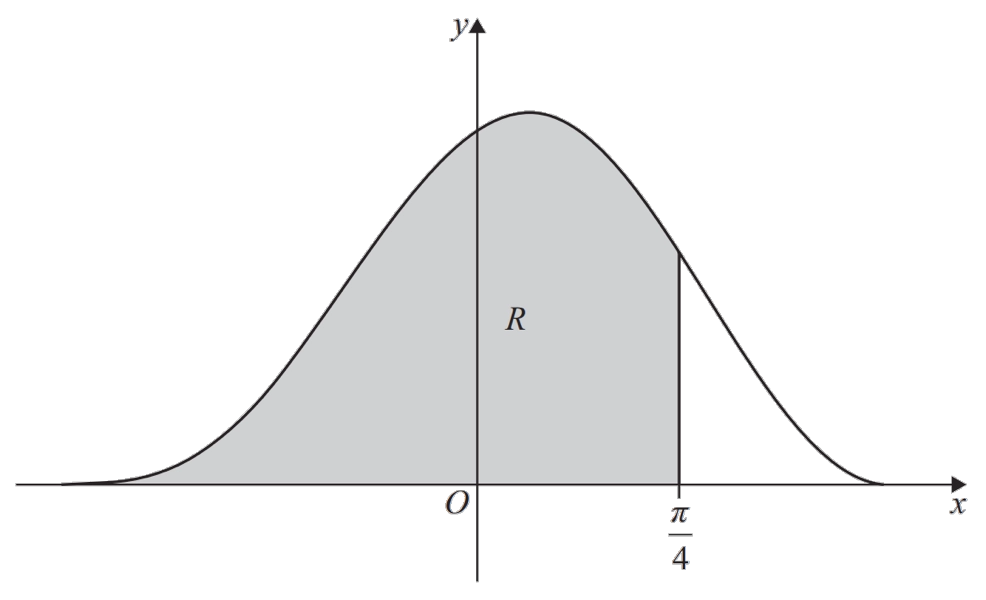
Figure 4
Figure 4 shows a sketch of the curve with equation
y=cos2x1+sinx−2π⩽x⩽2π
The region R , shown shaded in Figure 4, is bounded by the curve, the x-axis and the line with equation x=4π
The region R is rotated through 2π radians about the x-axis to form a solid of revolution.
(c) Use the answer to part (b) and algebraic integration to determine the exact volume of this solid.
Give the answer in the form 160π(p+qπ+r2) where p , q and r are integers.
(6)
解答
(a)
By De Moivre’s Theorem, for z=cosθ+isinθ:
zn=cos(nθ)+isin(nθ)
And for the reciprocal:
zn1=z−n==cos(−nθ)+isin(−nθ)cos(nθ)−isin(nθ)
Adding these two equations:
zn+zn1==(cos(nθ)+isin(nθ))+(cos(nθ)−isin(nθ))2cos(nθ)
(b)
Using the binomial expansion on (z+z1)4:
(z+z1)4===z4+4z3(z1)+6z2(z1)2+4z(z1)3+(z1)4z4+4z2+6+z24+z41(z4+z41)+4(z2+z21)+6
Using the result from (a), where zn+zn1=2cos(nθ), we can substitute:
(2cosθ)4=16cos4θ=cos4θ==(2cos4θ)+4(2cos2θ)+62cos4θ+8cos2θ+6161(2cos4θ+8cos2θ+6)81(cos4θ+4cos2θ+3)
This gives the required form, with a=4 and b=3.
(c)
The volume V of the solid of revolution formed by rotating the curve about the x-axis is:
V====π∫−2π4πy2dxπ∫−2π4π(cos2x1+sinx)2dxπ∫−2π4πcos4x(1+sinx)dxπ∫−2π4π(cos4x+cos4xsinx)dx
Using the identity from (b), we replace cos4x:
∫cos4xdx==∫81(cos4x+4cos2x+3)dx81(41sin4x+2sin2x+3x)
For the second part of the integral:
∫cos4xsinxdx=−51cos5x
Combining these, the indefinite integral is:
I=π[81(41sin4x+2sin2x+3x)−51cos5x]−2π4π
Now, evaluate at the upper limit x=4π:
===π(81(41sin(π)+2sin(2π)+3(4π))−51cos5(4π))π81(0+2+43π)−51(22)5π(41+323π−51(3242))π(41+323π−402)
Evaluate at the lower limit x=−2π:
==π(81(41sin(−2π)+2sin(−π)+3(−2π))−51cos5(−2π))π(81(0+0−23π)−0)−163ππ
Subtract the lower limit value from the upper limit value:
V===π(41+323π−402−(−163π))π(41+323π+326π−402)π(41+329π−402)
To write this over a common denominator of 160:
41=16040,329π=16045π,402=16042
Thus, the volume is:
V=160π(40+45π−42)