In this question you must show all stages of your working.
Solutions relying entirely on calculator technology are not acceptable.
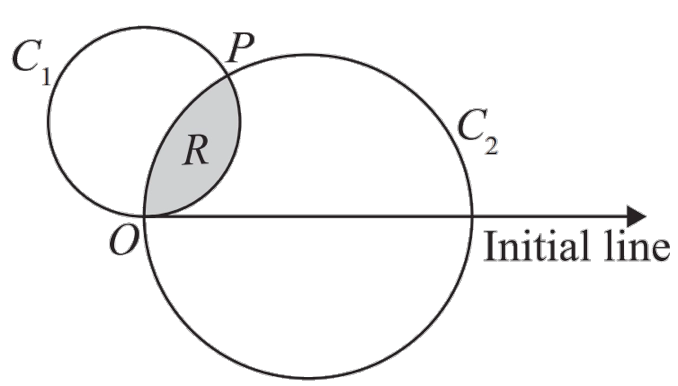
Figure 1
Figure 1 shows a sketch of the circles C1 and C2
The circle C1 has polar equation
r=3sinθ0⩽θ⩽π
The circle C2 has polar equation
r=3cosθ−2π⩽θ⩽2π
Circles C1 and C2 intersect at the origin O and at the point P.
(a) Determine the polar coordinates of P.
(2)
The finite region R is bounded by C1 and C2 and is shown shaded in Figure 1.
(b) Use algebraic integration to determine the exact area of R , giving your answer in the form aπ+b3 where a and b are simplified rational numbers.
(6)
解答
(a)
To find the intersection P, equate the two polar equations:
3sinθ=cosθsinθ=tanθ=3cosθ333
Since 0≤θ≤π/2 at the intersection P, we have:
θ=3π
Substitute θ back to find r:
r===3sin(3π)3(23)23
The polar coordinates of P are (23,3π).
(b)
The area R is split into two parts by the line OP (θ=π/3).
We integrate C1 from 0 to π/3, and C2 from π/3 to π/2:
Area=21∫03πr12dθ+21∫3π2πr22dθ
For the first integral:
21∫03π(3sinθ)2dθ======21∫03π3sin2θdθ23∫03π(21−21cos2θ)dθ43[θ−21sin2θ]03π43((3π−21sin32π)−0)43(3π−43)4π−1633
For the second integral:
21∫3π2π(3cosθ)2dθ=======21∫3π2π9cos2θdθ29∫3π2π(21+21cos2θ)dθ49[θ+21sin2θ]3π2π49((2π+0)−(3π+21sin32π))49(2π−3π−43)49(6π−43)83π−1693
Adding the two areas together:
Total Area===(4π−1633)+(83π−1693)85π−1612385π−433