题目
Problem
The curve C has equation
y=x21−9.
(a) Sketch the graph of C.
On your sketch
- show the coordinates of any points of intersection with the coordinate axes
- state clearly the equations of any asymptotes
(4)
The curve D has equation y=kx2 where k is a constant.
Given that C meets D at 4 distinct points,
(b) find the range of possible values for k.
(5)
解答
(a)
解法一
思路
展开
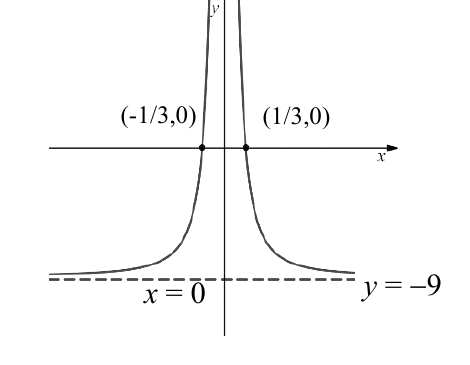
x21 永远为正,而且左右对称。减去 9 表示整张图像向下平移 9 个单位。因为 x=0 时无定义,所以 x=0 是竖直渐近线;当 ∣x∣ 很大时,x21→0,所以 y=−9 是水平渐近线。
答题过程
展开
For the x-intercepts, set y=0:
x21−9=x21=x2=x=0991±31.
So the x-intercepts are
(−31,0)and(31,0).
There is no y-intercept because x=0 is not in the domain.
The asymptotes are
x=0andy=−9.
The sketch should have two branches, symmetric about the y-axis, approaching x=0 vertically and approaching y=−9 horizontally.
(b)
解法一
思路
展开
交点满足两条曲线的 y 相等。整理后会得到关于 x 的四次方程。因为里面只出现 x2 和 x4,可以令 u=x2,这样变成关于 u 的二次方程。
要有 4 个不同交点,关于 u 的方程需要有两个不同的正根;每个正的 u 都会给出 x=±u 两个不同的 x 值。
答题过程
展开
At the points of intersection,
x21−9=kx2.
Multiply by x2:
1−9x2=kx4+9x2−1=kx40.
Let
u=x2.
Then
ku2+9u−1=0.
For the curve y=kx2 to meet C at 4 distinct points, the equation in u must have two distinct positive roots.
First, k must be negative. This makes the product of the two roots
k−1
positive, and the sum of the roots
k−9
positive.
The roots must also be distinct, so the discriminant must be positive:
b2−4ac92−4(k)(−1)81+4kk>0>0>0>−481.
Combining this with k<0 gives
−481<k<0.