题目
Problem
(a) Given that k is a positive constant such that 0<k<4 sketch, on separate axes, the graphs of
(i) y=(2x−k)(x+4)2
(ii) y=x2k
showing the coordinates of any points where the graphs cross or meet the coordinate axes, leaving coordinates in terms of k, where appropriate.
(5)
(b) State, with a reason, the number of roots of the equation
(2x−k)(x+4)2=x2k.
(1)
题目中文翻译
(a) 已知 k 是满足 0<k<4 的正常数。请在不同的坐标轴上分别画出下列图像:
(i) y=(2x−k)(x+4)2
(ii) y=x2k
标出图像与坐标轴相交或相切的所有点的坐标;适当时,坐标保留用 k 表示。
(b) 说明方程
(2x−k)(x+4)2=x2k
的根的个数,并说明理由。
解答
(a)(i)
解法一
思路
展开
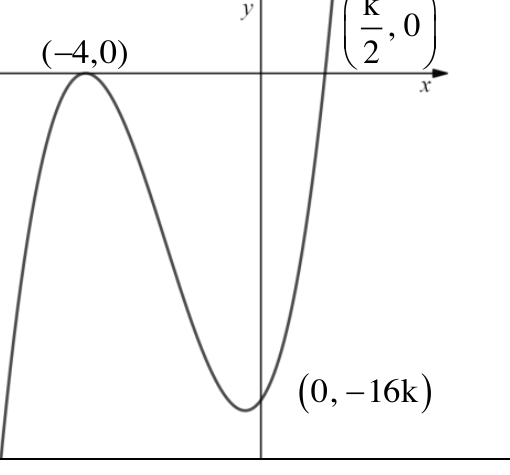
这是一个正首项系数的三次图像。因式 (x+4)2 给出 x=−4 的重根,所以图像在 (−4,0) 处接触 x 轴;因式 2x−k 给出 x=2k 的单根,所以图像在这里穿过 x 轴。
答题过程
展开
For
y=(2x−k)(x+4)2,
the x-intercepts are found from
(2x−k)(x+4)2=0.
So
x=2korx=−4.
The graph crosses the x-axis at
(2k,0),
and meets the x-axis at
(−4,0).
The y-intercept is found by setting x=0:
y==(2(0)−k)(0+4)2−16k.
So the y-intercept is
(0,−16k).
The sketch should be a positive cubic, touching the x-axis at (−4,0) and crossing the x-axis at (2k,0).
(a)(ii)
解法一
思路
展开
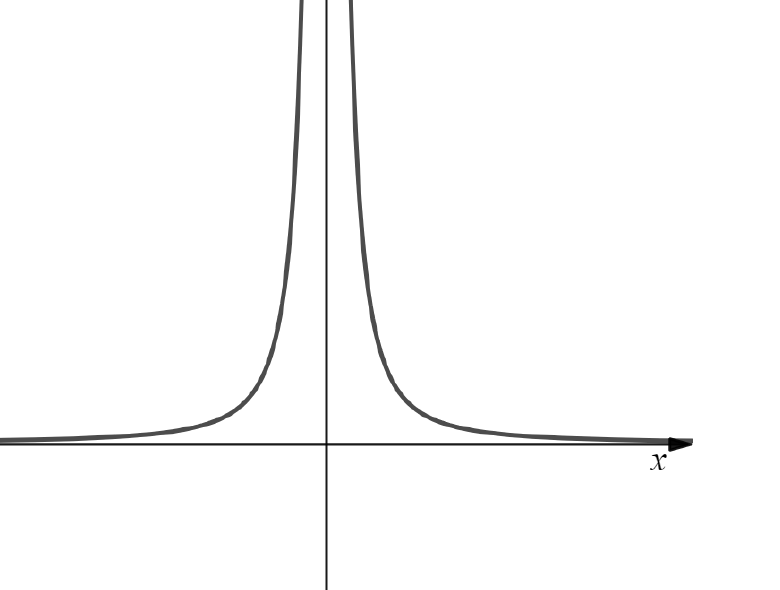
因为 k>0 且 x2>0,所以 y=x2k 永远为正。图像在第一、第二象限,靠近但不接触两条坐标轴。
答题过程
展开
For
y=x2k,
there are no intercepts with the coordinate axes.
The graph has two branches, one in quadrant I and one in quadrant II, with asymptotes
x=0andy=0.
(b)
解法一
思路
展开
方程的根数就是两张图像的交点个数。根据图像位置,三次图像与 y=x2k 只相交一次。
答题过程
展开
The number of roots is the number of intersections of the two graphs.
From the sketches, the graphs intersect once only.
Therefore the equation has
1
root.