题目
Problem
The curve C1 has equation
y=x(4−x2)
(a) Sketch the graph of C1 showing the coordinates of any points of intersection with the coordinate axes.
(3)
The curve C2 has equation y=xA where A is a constant.
(b) Show that the x coordinates of the points of intersection of C1 and C2 satisfy the equation
x4−4x2+A=0.
(1)
(c) Hence find the range of possible values of A for which C1 meets C2 at 4 distinct points.
(3)
题目中文翻译
曲线 C1 的方程为
y=x(4−x2).
(a) 画出 C1 的图像草图,并标出它与坐标轴所有交点的坐标。
(3)
曲线 C2 的方程为 y=xA,其中 A 为常数。
(b) 证明 C1 与 C2 交点的 x 坐标满足方程
x4−4x2+A=0.
(1)
(c) 由此求使 C1 与 C2 相交于 4 个不同点时,A 的所有可能取值范围。
(3)
解答
(a)
解法一
思路
展开
先把函数展开成 y=4x−x3,这是负三次函数形状。截距由 x(4−x2)=0 得到。
答题过程
展开
y=x(4−x2)=4x−x3.
The intersections with the coordinate axes occur when y=0:
x(4−x2)=x(2−x)(2+x)=00.
So
x=−2,x=0,x=2.
The sketch should be a negative cubic curve crossing the axes at
(−2,0),(0,0),(2,0).
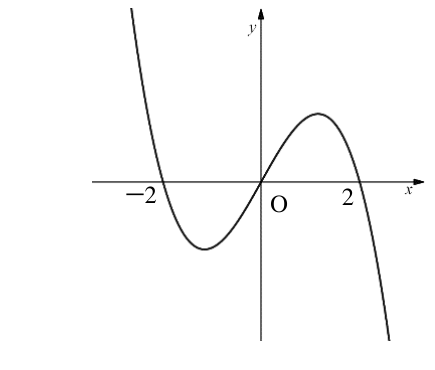
(b)
解法一
思路
展开
交点满足两个 y 相等。由于 C2 中有 xA,乘以 x 去分母即可。
答题过程
展开
At intersections,
x(4−x2)=xA.
Multiply by x:
x2(4−x2)=4x2−x4=AA.
Rearrange:
x4−4x2+A=0.
This is the required result.
(c)
解法一
思路
展开
令 u=x2,方程变成 u2−4u+A=0。要有 4 个不同的 x 值,需要这个关于 u 的二次方程有两个不同的正根。
答题过程
展开
Let
u=x2.
Then
x4−4x2+A=0
becomes
u2−4u+A=0.
For 4 distinct real x values, this equation must have two distinct positive u roots.
First, the product of the two u roots is A, so
A>0.
Also, the roots must be distinct:
b2−4ac(−4)2−4(1)(A)16−4AA>0>0>0<4.
Therefore
0<A<4.
解法二
思路
展开
把交点方程写成 4x2−x4=A,并考察偶函数 g(x)=4x2−x4。它在 x=0 处取值 0,在 x=±2 处取得最大值 4。水平直线 y=A 只有在 0<A<4 时才会与两侧的隆起各相交两次,共得到四个非零的不同 x 值。
答题过程
展开
Rewrite the equation as
4x2−x4=A.
Let g(x)=4x2−x4. Completing the square in x2 gives
g(x)==4x2−x44−(x2−2)2.
Thus g(0)=0, while the maximum value is 4 at x=±2. On each of the intervals (−2,0) and (0,2), the graph rises from 0 to 4 and returns to 0.
Therefore the horizontal line y=A cuts the graph at four distinct nonzero points precisely when
0<A<4.