题目
Problem
In this question you must show all stages of your working.
Solutions relying entirely on calculator technology are not acceptable.
The curve C has equation
y=x2−k
where k is a positive constant.
(a) Sketch the graph of C.
Show on your sketch
- the coordinates of any points of intersection of C with the coordinate axes
- the equation of the horizontal asymptote to C
stating each in terms of k.
(3)
The line l has equation y=−kx−6.
Given that l intersects C at 2 distinct points,
(b) find the range of possible values of k.
(5)
解答
(a)
解法一
思路
展开
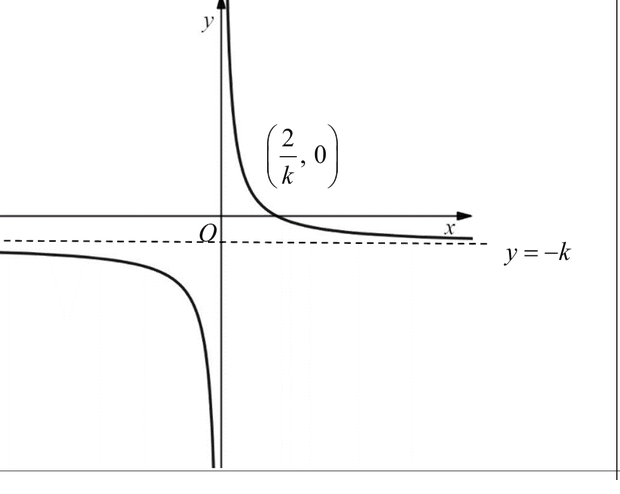
y=x2−k 是 y=x2 向下平移 k。因此水平渐近线是 y=−k。与 x 轴交点令 y=0;没有 y 轴交点,因为 x=0 不在定义域内。
答题过程
展开
The horizontal asymptote is
y=−k.
For the x-intercept, set y=0:
x2−k=x2=x=0kk2.
So the curve intersects the x-axis at
(k2,0).
There is no y-intercept because x=0 is not allowed.
A completed sketch is:
(b)
解法一
思路
展开
两条图像有两个不同交点,等价于联立后关于 x 的二次方程有两个不同实根。因此判别式要大于 0。同时题目给出 k>0。
答题过程
展开
At intersections,
−kx−6=x2−k.
Multiply by x:
−kx2−6x=2−kx.
Bring all terms to one side:
kx2+(6−k)x+2=0.
For two distinct intersections,
Δ>0.
So
(6−k)2−4(k)(2)k2−12k+36−8kk2−20k+36>0>0>0.
Factorise:
k2−20k+36=(k−2)(k−18).
Since the quadratic is positive outside its roots,
k<2ork>18.
Given k>0,
0<k<2ork>18.