题目
Problem
The line l1, shown in Figure 1, has equation 2y=3x+8.
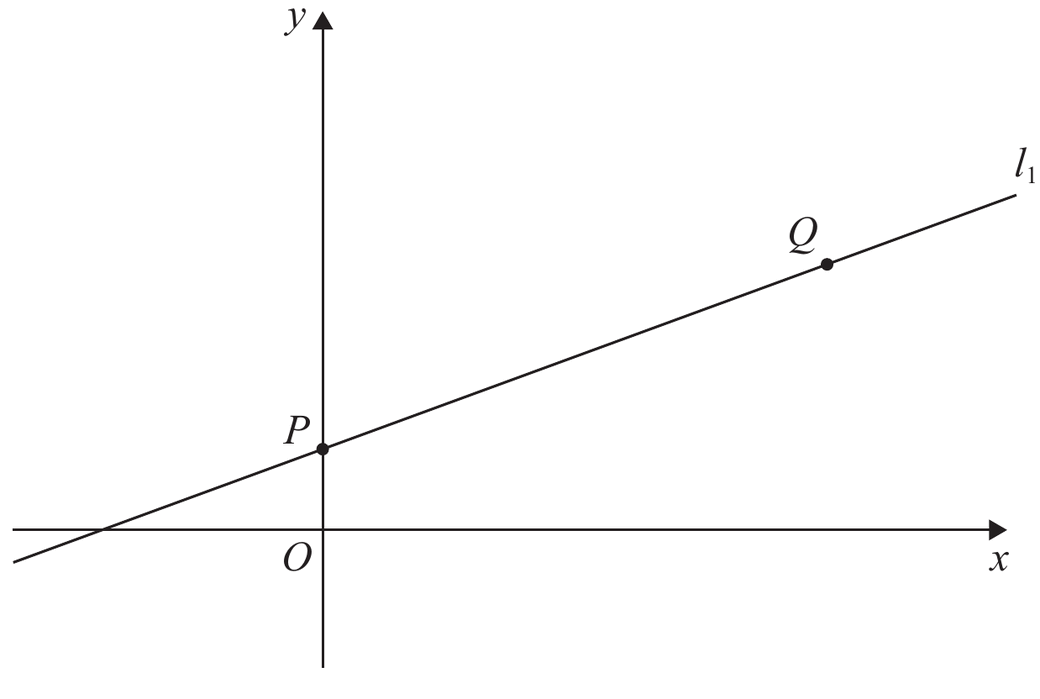
Figure 1
The line l1 intersects the y-axis at the point P and passes through the point Q with
x coordinate 6.
(a) Find
(i) the coordinates of P,
(ii) the coordinates of Q.
(2)
The line l2 is perpendicular to l1 and passes through the point Q.
(b) Find an equation for l2, writing the answer in the form ax+by+c=0, where a, b
and c are integers.
(4)
The line l2 cuts the x-axis at the point R.
(c) Find the area of quadrilateral OPQR, making the method clear.
(3)
解答
(a)
解法一
思路
展开
P 在 y 轴上,所以 x=0。Q 的 x 坐标已给为 6,分别代入直线方程即可。
答题过程
展开
For P, put x=0:
2y=y=3(0)+84.
So
P=(0,4).
For Q, put x=6:
2y=2y=y=3(6)+82613.
So
Q=(6,13).
(b)
解法一
思路
展开
先从 2y=3x+8 读出 l1 的斜率,再取负倒数得到垂线 l2 的斜率。最后用 Q(6,13) 代入点斜式。
答题过程
展开
Since
2y=y=3x+823x+4,
the gradient of l1 is 23.
Therefore the gradient of l2 is
−3/21=−32.
Using Q(6,13),
y−13=3y−39=2x+3y−51=−32(x−6)−2x+120.
(c)
解法一
思路
展开
先求出 R,再把四边形拆成两个三角形:△OPQ 和 △OQR。这样底边都可以放在坐标轴方向或用水平距离,计算很直接。
答题过程
展开
At R, y=0. Using 2x+3y−51=0,
2x−51=x=0251.
So
R=(251,0).
The area of △OPQ is
21×OP×6==21×4×612.
The area of △OQR is
21×OR×13==21×251×134663.
Therefore
area of OPQR===12+46634711177.75.