题目
Problem
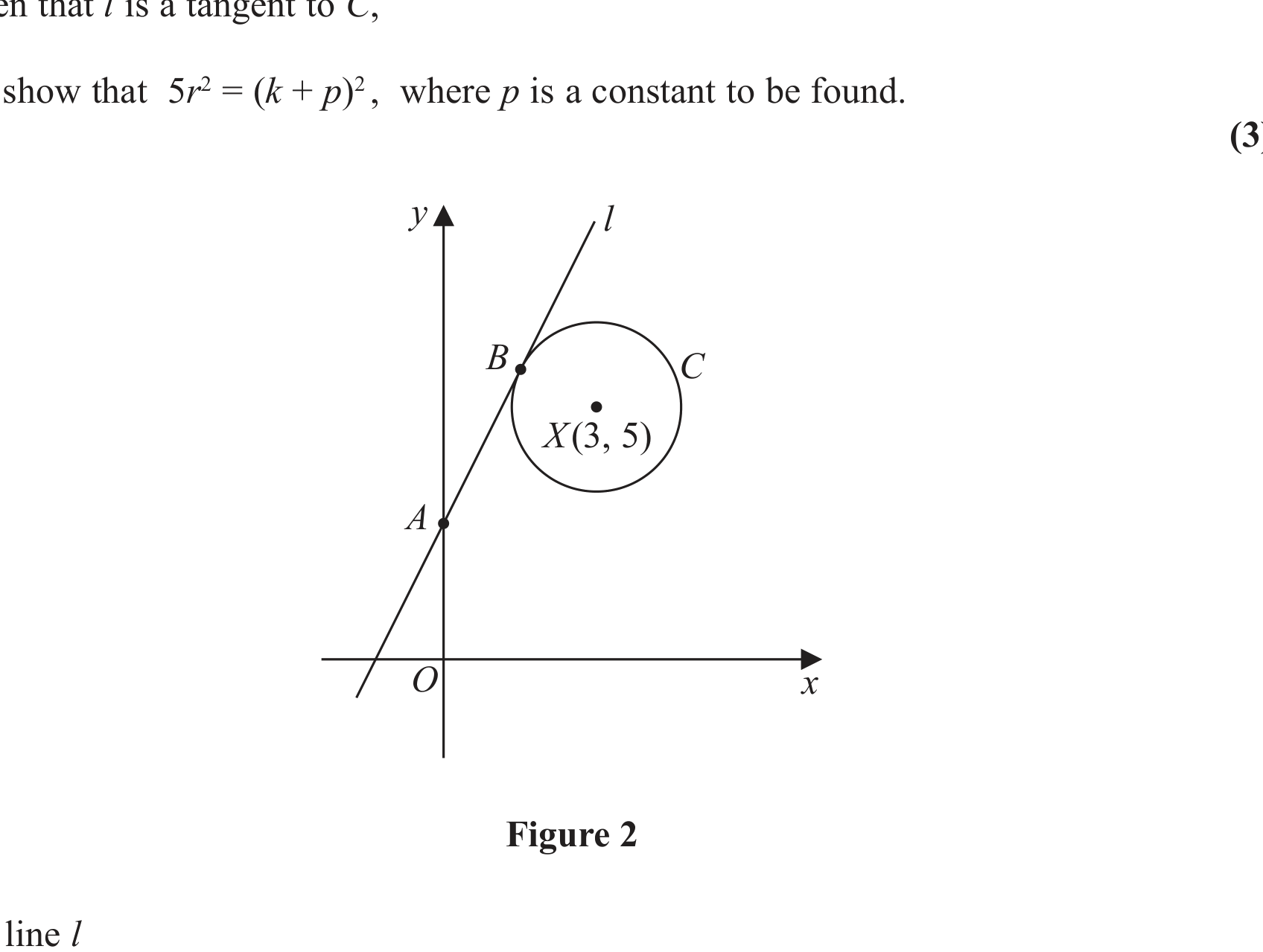
The circle C has centre X(3,5) and radius r.
The line l has equation y=2x+k, where k is a constant.
(a) Show that l and C intersect when
5x2+(4k−26)x+k2−10k+34−r2=0
(3)
Given that l is a tangent to C,
(b) show that 5r2=(k+p)2, where p is a constant to be found.
(3)
The line l
- cuts the y-axis at the point A
- touches the circle C at the point B
as shown in Figure 2.
Given that AB=2r
(c) find the value of k
(6)
题目中文翻译
圆 C 的圆心为 X(3,5),半径为 r。
直线 l 的方程为 y=2x+k,其中 k 为常数。
(a) 证明:直线 l 与圆 C 相交的交点 x 坐标满足方程:
5x2+(4k−26)x+k2−10k+34−r2=0
(3)
已知 l 是圆 C 的一条切线,
(b) 证明 5r2=(k+p)2,其中 p 是一个待求的常数。 (3)
直线 l
- 与 y 轴交于点 A
- 与圆 C 相切于点 B
如图 2 所示。
已知线段长度 AB=2r,
(c) 求出 k 的值。 (6)
解答
(a)
解法一
思路
展开
首先利用圆心坐标 X(3,5) 和半径 r 写出圆 C 的标准方程:
(x−3)2+(y−5)2=r2
为了求交点,我们将直线方程 y=2x+k 代入到圆方程中消去 y:
(x−3)2+(2x+k−5)2=r2
分别展开这两项,并整理成关于 x 的一元二次方程形式:
- 展开第一项:(x−3)2=x2−6x+9
- 展开第二项:将其视为 [2x+(k−5)]2=4x2+4(k−5)x+(k−5)2=4x2+(4k−20)x+(k2−10k+25)
- 两部分合并相加并令右侧为 0,即可得到待证的一元二次方程。
答题过程
展开
The standard equation of a circle with centre X(3,5) and radius r is:
(x−3)2+(y−5)2=r2
Substitute the equation of the line l:y=2x+k into the circle equation:
(x−3)2+(2x+k−5)2=r2
Expand each term:
(x−3)2=x2−6x+9
(2x+k−5)2===(2x+(k−5))24x2+2(2x)(k−5)+(k−5)24x2+(4k−20)x+(k2−10k+25)
Sum the expanded terms:
(x2−6x+9)+(4x2+(4k−20)x+k2−10k+25)=r2
Combine like terms:
(1+4)x2+(−6+4k−20)x+k2−10k+9+25−r2=0
5x2+(4k−26)x+k2−10k+34−r2=0
This matches the printed equation.
(b)
解法一
思路
展开
因为直线 l 是圆 C 的切线(Tangent),所以在几何上它们只有一个公共交点。
这意味着联立后关于 x 的一元二次方程:
5x2+(4k−26)x+k2−10k+34−r2=0
有且仅有一个重根(唯一实数解)。
所以,该一元二次方程的判别式(Discriminant)必须等于零,即:
Δ=B2−4AC=0
其中:
- A=5
- B=4k−26
- C=k2−10k+34−r2
代入并展开这个判别式方程:
(4k−26)2−4×5×(k2−10k+34−r2)=0
展开并合并同类项,然后整理出 5r2=(k+p)2 的形式,确定常数 p 的值。
答题过程
展开
Since the line l is a tangent to the circle C, the quadratic equation from part (a) must have exactly one real solution. Thus, its discriminant must be zero:
Δ=b2−4ac=0
Identify the coefficients:
- a=5
- b=4k−26
- c=k2−10k+34−r2
Set the discriminant to 0:
(4k−26)2−4(5)(k2−10k+34−r2)=0
Expand both terms:
(4k−26)2=16k2−208k+676
20(k2−10k+34−r2)=20k2−200k+680−20r2
Subtract the second expression from the first:
(16k2−208k+676)−(20k2−200k+680−20r2)=0
−4k2−8k−4+20r2=0
Move 20r2 to the other side:
20r2=4k2+8k+4
Divide the entire equation by 4:
5r2=k2+2k+1
Factorize the quadratic on the right-hand side:
5r2=(k+1)2
This is in the form 5r2=(k+p)2 with p=1.
(c)
解法一:几何法(直角三角形勾股定理)
思路
展开
由几何关系,切点 B 处半径与切线垂直,即圆心 X 到切点 B 的连线 XB⊥AB。
因此,三角形 △ABX 是一个以 B 为直角的直角三角形。
- 直角边 XB=r (圆的半径)
- 直角边 AB=2r (题目已知条件)
- 斜边为 AX
利用直角三角形的勾股定理(Pythagoras’ Theorem):
AX2=XB2+AB2=r2+(2r)2=r2+4r2=5r2
根据第 (b) 问的结论,我们知道:
5r2=(k+1)2
所以:
AX2=(k+1)2
接着,我们可以求出点 A 的坐标:
因为直线 l 的方程是 y=2x+k,点 A 是直线与 y 轴的交点,令 x=0 得到 y=k。
因此点 A 的坐标为 (0,k)。
又已知圆心为 X(3,5)。利用两点距离公式求出斜边平方 AX2:
AX2=(xX−xA)2+(yX−yA)2=(3−0)2+(5−k)2=9+(k−5)2
建立方程:
(k+1)2=9+(k−5)2
展开并解出 k 的值即可。
答题过程
展开
Since the line l is tangent to the circle C at point B, the radius XB is perpendicular to the tangent line at B. Thus, △ABX is a right-angled triangle with ∠ABX=90∘.
Using Pythagoras’ theorem:
AX2=XB2+AB2
Given XB=r and AB=2r:
AX2=r2+(2r)2=5r2
From part (b), we know 5r2=(k+1)2. Therefore:
AX2=(k+1)2— (Equation 1)
Point A is the intersection of line l:y=2x+k with the y-axis, so its coordinates are:
A(0,k)
The centre of the circle is X(3,5). Use the distance formula to express AX2:
AX2====(3−0)2+(5−k)29+(k−5)29+k2−10k+25k2−10k+34— (Equation 2)
Equate Equation 1 and Equation 2:
(k+1)2=k2−10k+34
k2+2k+1=k2−10k+34
Eliminate k2 from both sides:
2k+1=−10k+34
12k=33
k=1233=411=2.75
解法二:代数法(利用重根计算切点 B 坐标)
思路
展开
我们也可以用代数消元法来做。
因为 l 与圆相切,根据 (a) 问的方程:
5x2+(4k−26)x+k2−10k+34−r2=0
它是一个只有一个实根的二次方程,因此切点 B 的 x 坐标就是这个方程的重根:
xB=−2AB=−2×54k−26=1026−4k=513−2k
由于 B 落在直线 y=2x+k 上,其 y 坐标为:
yB=2xB+k=2(513−2k)+k=526−4k+5k=526+k
点 A 的坐标为 (0,k)。利用距离公式写出 AB2(即切线段长度的平方):
AB2=(xB−xA)2+(yB−yA)2=(513−2k−0)2+(526+k−k)2
简化后得到关于 k 的表达式。
因为已知条件为 AB=2r⟹AB2=4r2。
又从 (b) 问中已知 r2=5(k+1)2,我们可以将 AB2=4r2 改写为:
AB2=54(k+1)2
两边联立并消去分母,可以解出 k。这种纯代数法不依赖几何直觉,也是一种非常标准的方法。
答题过程
展开
Since B is the point of contact, its x-coordinate xB is the unique double root of the quadratic equation from (a):
xB=−2ab=−2×54k−26=1026−4k=513−2k
Substitute xB into the line equation to find yB:
yB=2xB+k=2(513−2k)+k=526+k
The coordinates of A are (0,k). Calculate the squared distance AB2:
AB2=====(xB−xA)2+(yB−yA)2(513−2k−0)2+(526+k−k)2(513−2k)2+(526−4k)225(13−2k)2+4(13−2k)2255(13−2k)2=5(13−2k)2
Given AB=2r⟹AB2=4r2. From part (b), we have r2=5(k+1)2, so:
AB2=54(k+1)2
Equate the two expressions for AB2:
5(13−2k)2=54(k+1)2
Multiply by 5 and take the square root of both sides:
13−2k=±2(k+1)
Solve the two linear equations:
-
Case A:
13−2k=2(k+1)⟹13−2k=2k+2⟹4k=11⟹k=2.75
-
Case B:
13−2k=−2(k+1)⟹13−2k=−2k−2⟹13=−2(no solution)
Thus, the value of k is 2.75.