题目
Problem
In this question you must show all stages of your working.
Solutions based entirely on calculator technology are not acceptable.
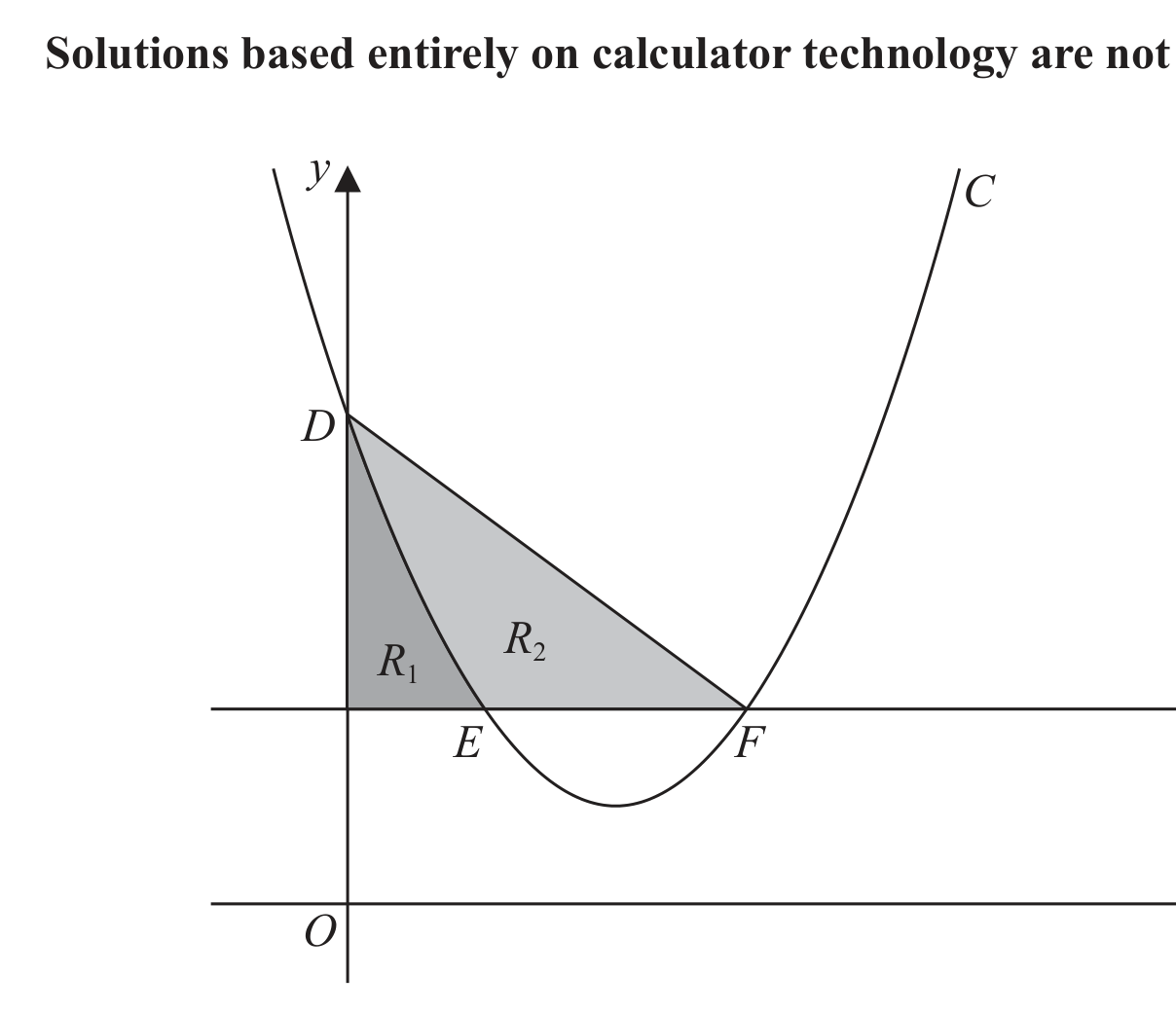
Figure 3 shows
- the curve C with equation y=x2−4x+5
- the line l with equation y=2
The curve C intersects the y-axis at the point D.
(a) Write down the coordinates of D.
(1)
The curve C intersects the line l at the points E and F, as shown in Figure 3.
(b) Find the x coordinate of E and the x coordinate of F.
(2)
Shown shaded in Figure 3 is
- the region R1 which is bounded by C, l and the y-axis
- the region R2 which is bounded by C and the line segments EF and DF
Given that area of R2area of R1=k, where k is a constant,
(c) use algebraic integration to find the exact value of k, giving your answer as a simplified fraction.
(5)
解答
(a)
解法一
思路
展开
曲線 C 與 y 軸相交於點 D,即該點的 x 坐標為 0。
將 x=0 代入曲線方程 y=x2−4x+5,即可求出 D 的 y 坐标,寫出坐標形式即可。
答题过程
展开
The curve C intersects the y-axis at point D. Substituting x=0 into the equation of C:
y=02−4(0)+5=5.
Therefore, the coordinates of D are:
(0,5).
(b)
解法一
思路
展开
點 E 和 F 是曲線 C 與直線 l:y=2 的交點。
聯立方程,令 x2−4x+5=2,得到一個一元二次方程,因式分解解出兩個根。
根據圖中位置,較小的根為 E 的 x 坐標,較大的根為 F 的 x 坐標。
答题过程
展开
Set the equation of curve C equal to the equation of line l:
x2−4x+5=x2−4x+3=(x−1)(x−3)=200.
Solving for x gives x=1 or x=3.
Since E lies to the left of F:
- The x coordinate of E is 1.
- The x coordinate of F is 3.
(c)
解法一
思路
展开
本題需要分別求出區域 R1 和 R2 的面積:
- 計算 Area(R1):
區域 R1 在 x∈[0,1] 區間內,由曲線 C(上方)和直線 y=2(下方)圍成。
Area(R1)=∫01(yC−yl)dx=∫01(x2−4x+5−2)dx=∫01(x2−4x+3)dx
- 計算 Area(R2):
- 方法一:割補法。區域 R2 可以看作是直線段 DF 下方的梯形面積,減去曲線 C 下方的面積。
- 直線段 DF 連接 D(0,5) 和 F(3,2)。其下方的投影是一個直角梯形,上底為 5,下底為 2,高為 3。
Area(Trapezium)=25+2×3=221
- 曲線 C 下方的面積(從 x=0 到 x=3)可以分為兩部分:
- 在 x∈[0,1] 上,是曲線 C 下方的面積:∫01(x2−4x+5)dx。
- 在 x∈[1,3] 上,是直線 y=2 下方的矩形面積:2×2=4。
- 故曲線 C 下方的總面積為:
∫01(x2−4x+5)dx+4=310+4=322
- 區域 R2 的面積為:
Area(R2)=221−322=619
- 計算比值 k:
k=Area(R2)Area(R1)=19/64/3=198
答题过程
展开
Step 1: Find the Area of R1
The region R1 is bounded above by the curve C and below by the line y=2 from x=0 to x=1.
Area(R1)======∫01((x2−4x+5)−2)dx∫01(x2−4x+3)dx[31x3−2x2+3x]01(31(1)3−2(1)2+3(1))−031−2+334.
Step 2: Find the Area of R2
First, find the equation of the line segment DF connecting D(0,5) and F(3,2).
The gradient of DF is:
mDF=3−02−5=−1.
Since the y-intercept is 5, the equation of the line DF is:
y=−x+5.
The region R2 is bounded above by the line segment DF and below by:
- The curve C from x=0 to x=1.
- The line y=2 from x=1 to x=3.
We can calculate the area of R2 by subtracting the area under the bottom boundary from the area of the trapezium under the line segment DF (from x=0 to x=3).
-
Area of the trapezium under DF:
Areatrap=25+2×3=221.
-
Area under the bottom boundary:
For x∈[0,1], the area under the curve C is:
AreaC====∫01(x2−4x+5)dx[31x3−2x2+5x]0131−2+5310.
For x∈[1,3], the area under the line y=2 is a rectangle of width 2 and height 2:
Arearect=2×2=4.
So, the total area under the bottom boundary is:
Areabottom=310+4=322.
-
Area of R2:
Area(R2)====Areatrap−Areabottom221−322663−44619.
Step 3: Calculate the value of k
k====Area(R2)Area(R1)6193434×196198.
Therefore, the exact value of k is 198.