
题目
Problem
The curve has equation
where is a positive constant.
(a) Show that
where and are integers to be found.
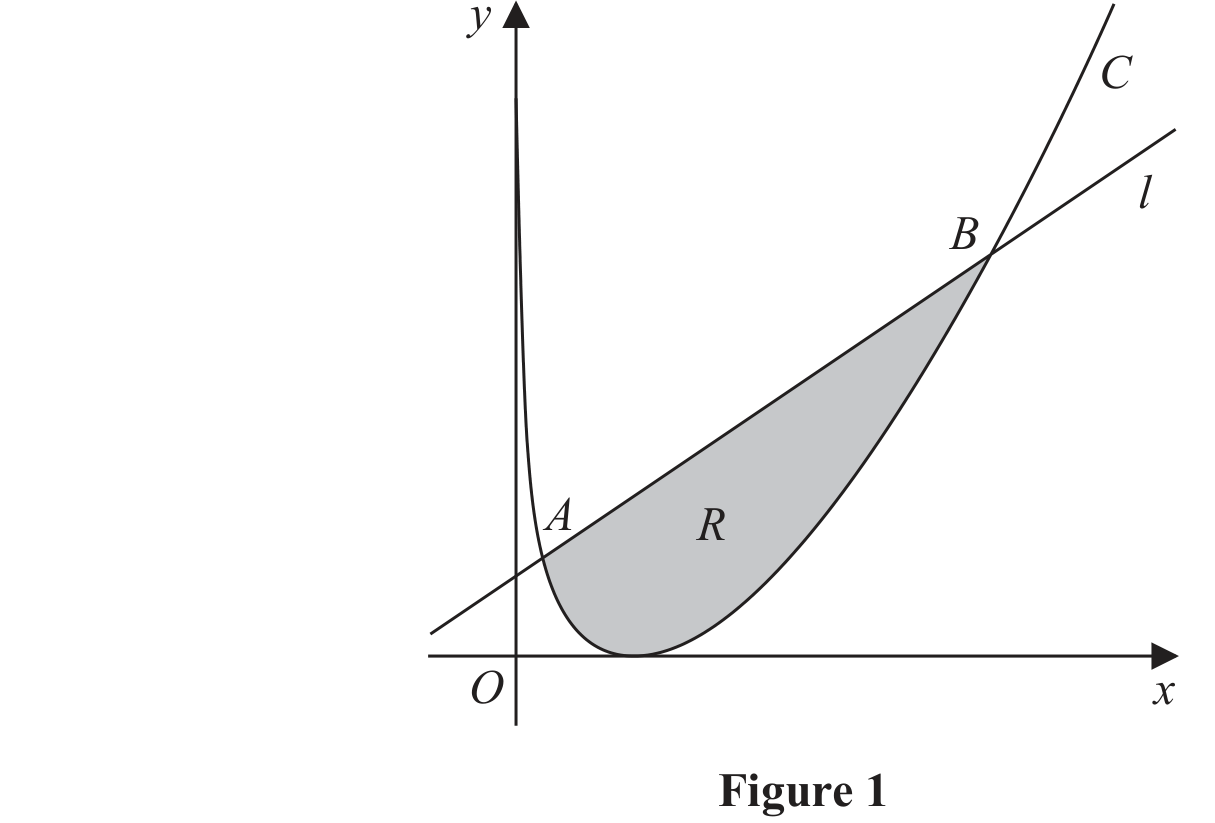
Figure 1 shows a sketch of the curve and the line .
Given that intersects at the point and at the point where is a constant,
(b) show that
The region , shown shaded in Figure 1, is bounded by and .
Using the answers to parts (a) and (b),
(c) find the area of region
(10)
题目中文翻译
曲线 的方程为 (),其中 为正常数。
(a) 证明 ,其中 为待求整数。
图1为曲线 和直线 的示意图。已知 与 交于 和 。
(b) 证明
(c) 求阴影区域 的面积。
(10分)
解答
解法一
思路
展开 ,除以 ,逐项积分(幂函数积分),再代入上下限。 在曲线上,代入求 。区域 面积 = 直线下方面积 − 曲线下方面积。
答题过程
(a)
\frac{(x-k)^2}{\sqrt{x}} =&\, \frac{x^2 - 2kx + k^2}{x^{1/2}} \\[4mm] =&\, x^{3/2} - 2kx^{1/2} + k^2 x^{-1/2} \end{align*}$$ $$\begin{align*} \int_1^{16} \left(x^{3/2} - 2kx^{1/2} + k^2 x^{-1/2}\right)\mathrm{d}x \end{align*}$$ $$\begin{align*} =&\, \left[\frac{2}{5}x^{5/2} - \frac{4k}{3}x^{3/2} + 2k^2 x^{1/2}\right]_1^{16} \end{align*}$$ At $x = 16$: $x^{1/2} = 4$, $x^{3/2} = 64$, $x^{5/2} = 1024$ $$\begin{align*} =&\, \left(\frac{2048}{5} - \frac{256k}{3} + 8k^2\right) - \left(\frac{2}{5} - \frac{4k}{3} + 2k^2\right) \\[4mm] =&\, 6k^2 - \frac{252k}{3} + \frac{2046}{5} \\[4mm] =&\, 6k^2 - 84k + \frac{2046}{5} \end{align*}$$ $$\boxed{6k^2 - 84k + \frac{2046}{5}}$$ So $a = 6$ and $b = -84$. **(b)** Since $A(1, 9)$ lies on $C$: $$\begin{align*} 9 =&\, \frac{(1-k)^2}{\sqrt{1}} = (1-k)^2 \\[4mm] 1 - k =&\, \pm 3 \\[4mm] k =&\, -2 \quad \text{or} \quad k = 4 \end{align*}$$ Since $k$ is a **positive** constant: $$\boxed{k = 4}$$ **(c)** With $k = 4$, the integral from part (a) gives: $$\int_1^{16} \frac{(x-4)^2}{\sqrt{x}}\,\mathrm{d}x = 6(16) - 84(4) + \frac{2046}{5} = 96 - 336 + 409.2 = 169.2$$ At $B(16, q)$: $q = \dfrac{(16-4)^2}{\sqrt{16}} = \dfrac{144}{4} = 36$. Line $l$ through $A(1, 9)$ and $B(16, 36)$: $$m = \frac{36 - 9}{16 - 1} = \frac{27}{15} = \frac{9}{5}$$ Area of region $R$: $$\begin{align*} \text{Area} =&\, \int_1^{16} \left(\frac{9}{5}x + \frac{36}{5}\right)\mathrm{d}x - 169.2 \\[4mm] =&\, \left[\frac{9}{10}x^2 + \frac{36}{5}x\right]_1^{16} - 169.2 \\[4mm] =&\, \left(\frac{9}{10}(256) + \frac{36}{5}(16)\right) - \left(\frac{9}{10} + \frac{36}{5}\right) - 169.2 \\[4mm] =&\, (230.4 + 115.2) - (0.9 + 7.2) - 169.2 \\[4mm] =&\, 345.6 - 8.1 - 169.2 \\[4mm] =&\, \frac{1683}{10} \end{align*}$$ $$\boxed{\frac{1683}{10}}$$ ## 解法二 #### 思路 (c) 的另一种方法:直线 $l$ 下方的面积可以用梯形公式直接计算(不需要积分),再减去 (a) 中曲线下的积分结果。 #### 答题过程 **(c)** With $k = 4$, the area under curve $C$ from part (a) is $169.2$. At $B(16, q)$: $q = \dfrac{(16-4)^2}{\sqrt{16}} = 36$. The line $l$ passes through $A(1, 9)$ and $B(16, 36)$. The area under $l$ from $x = 1$ to $x = 16$ is a trapezium with parallel sides $9$ and $36$, and height $15$: $$\text{Area of trapezium} = \frac{1}{2}(9 + 36) \times 15 = \frac{1}{2} \times 45 \times 15 = \frac{675}{2} = 337.5$$ Area of region $R$: $$\text{Area} = 337.5 - 169.2 = \frac{675}{2} - \frac{846}{5} = \frac{3375 - 1692}{10} = \frac{1683}{10}$$ $$\boxed{\frac{1683}{10}}$$