题目
Problem
In this question you must show all stages of your working.
Solutions relying entirely on calculator technology are not acceptable.
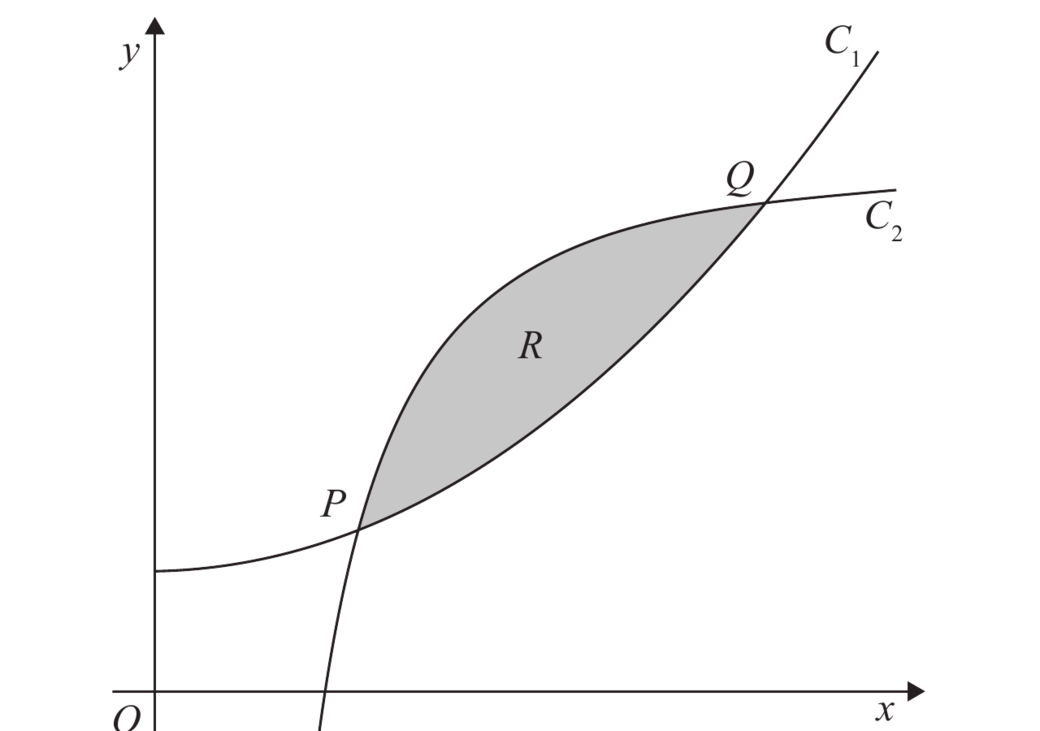
Figure 1
Figure 1 shows a sketch of part of the curve C1 with equation
y=x2+3,x>0
and part of the curve C2 with equation
y=13−x29,x>0
The curves C1 and C2 intersect at the points P and Q as shown in Figure 1.
(a) Use algebra to find the x coordinate of P and the x coordinate of Q.
(4)
The finite region R, shown shaded in Figure 1, is bounded by C1 and C2
(b) Use algebraic integration to find the exact area of R.
(4)
解答
(a)
解法一
思路
展开
交点处两个 y 相等。因为有 x29,先乘以 x2,把它化成关于 x2 的二次方程。
答题过程
展开
At the intersections,
x2+3=13−x29.
Multiply by x2:
x4+3x2=x4−10x2+9=13x2−90.
Factorise as a quadratic in x2:
(x2−1)(x2−9)=0.
So
x2=1orx2=9.
Since x>0,
x=1orx=3.
Therefore, the x coordinates of P and Q are 1 and 3.
(b)
解法一
思路
展开
在 1<x<3 上,上方曲线是 C2,下方曲线是 C1。面积是上减下的积分。
答题过程
展开
The area is
∫13(13−x29−(x2+3))dx.
Simplify:
13−x29−(x2+3)=10−9x−2−x2.
So
Area=====∫13(10−9x−2−x2)dx[10x+9x−1−3x3]13(30+3−9)−(10+9−31)24−356316.
Therefore, the exact area of R is
316.