题目
Problem
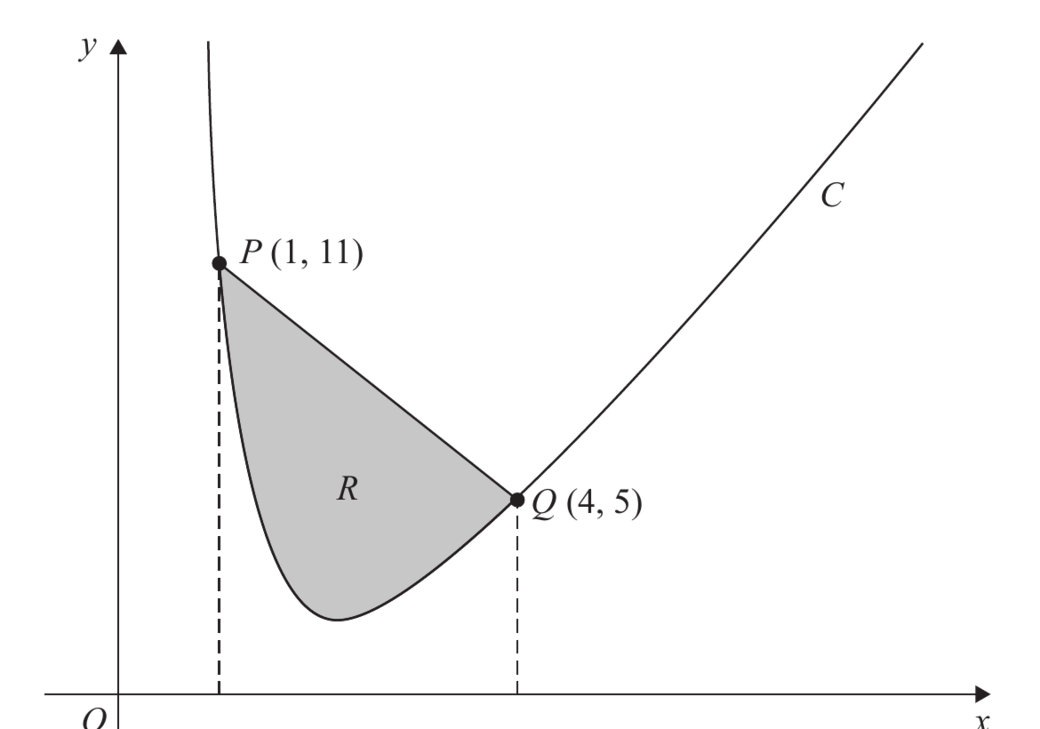
Figure 1
In this question you must show all stages of your working.
Solutions relying entirely on calculator technology are not acceptable.
Figure 1 shows a sketch of the curve C with equation
y=3x+x216−8,x>0
The points P(1,11) and Q(4,5) lie on C and are shown in Figure 1.
The region R, shown shaded in Figure 1, is bounded by C and line segment PQ.
Use algebraic integration to find the area of R.
(5)
解答
解法一
思路
展开
线段 PQ 和 x-axis 形成一个 trapezium,曲线在下面。区域面积可以用梯形面积减去曲线下面积。
答题过程
展开
The area of the trapezium with parallel sides 11 and 5 and width 3 is
21(11+5)(4−1)=24.
Now integrate the curve:
∫(3x+x216−8)dx===∫(3x+16x−2−8)dx23x2−16x−1−8x23x2−x16−8x.
The area under the curve from x=1 to x=4 is
[23x2−x16−8x]14===(24−4−32)−(23−16−8)−12−(−245)221.
Therefore,
area of R==24−221227.
解法二
思路
展开
也可以先求直线 PQ 的方程,然后直接积分“直线减曲线”。这样区域含义最直接。
答题过程
展开
The gradient of PQ is
4−15−11=−2.
Using P(1,11), the equation of PQ is
y−11=y=−2(x−1)13−2x.
The area of R is
∫14[(13−2x)−(3x+x216−8)]dx.
Simplify the integrand:
(13−2x)−(3x+x216−8)=21−5x−x216.
So
area of R=====∫14(21−5x−16x−2)dx[21x−25x2+16x−1]14(84−40+4)−(21−25+16)48−269227.