
Skip to content
CalcGospel 國際數學圖譜
返回

IAL 2022 Oct Q3

A Level / Edexcel / P3

IAL 2022 Oct Paper · Question 3

题目

Problem

In this question you must show all stages of your working.

Solutions relying entirely on calculator technology are not acceptable.
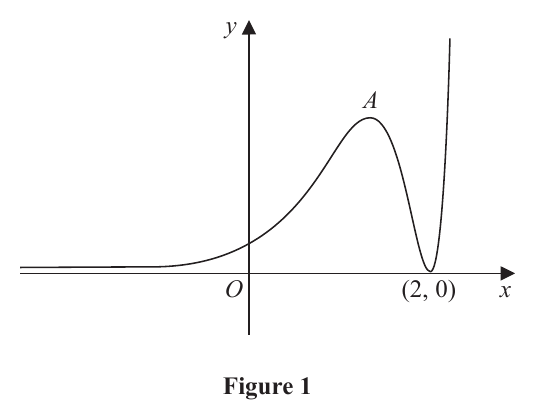
Figure 1 shows a sketch of part of the curve with equation y=f(x)y=f(x) where

f(x)=(x2)2e3xxRf(x)=(x-2)^2e^{3x}\qquad x\in\mathbb{R}

The curve has a maximum turning point at AA and a minimum turning point at (2,0)(2,0).

(a) Use calculus to find the exact coordinates of AA.

(5)

Given that the equation f(x)=kf(x)=k, where kk is a constant, has at least two distinct roots,

(b) state the range of possible values for kk.

(2)
题目中文翻译

本题中你必须写出解题过程的所有步骤。

不接受完全依赖计算器技术的解法。

图 1 给出了部分曲线 y=f(x)y=f(x) 的示意图,其中

f(x)=(x2)2e3xxRf(x)=(x-2)^2e^{3x}\qquad x\in\mathbb{R}

该曲线在点 AA 处有一个极大转折点,在 (2,0)(2,0) 处有一个极小转折点。

(a) 用微积分求点 AA 的精确坐标。

已知方程 f(x)=kf(x)=k(其中 kk 是常数)至少有两个不同的根。

(b) 写出 kk 的可能取值范围。

解答

(a)

We have

f(x)=(x2)2e3xf(x)=(x-2)^2e^{3x}

求导得

f(x)=2(x2)e3x+(x2)23e3xf'(x)=2(x-2)e^{3x}+(x-2)^2\cdot3e^{3x}

Factorise:

f(x)=e3x(x2)[2+3(x2)]f'(x)=e^{3x}(x-2)\left[2+3(x-2)\right]

So

f(x)=e3x(x2)(3x4)f'(x)=e^{3x}(x-2)(3x-4)

At a turning point,

f(x)=0f'(x)=0

Since

e3x>0e^{3x}>0

we have

x2=0x-2=0

or

3x4=03x-4=0

Thus

x=2orx=43x=2 \qquad\text{or}\qquad x=\frac43

The point (2,0)(2,0) is the minimum point, so AA has

x=43x=\frac43

Now find the yy coordinate:

y=(432)2e3(4/3)y=\left(\frac43-2\right)^2e^{3(4/3)}

So

y=(23)2e4=49e4y=\left(-\frac23\right)^2e^4 =\frac49e^4

Therefore

A=(43,49e4)\boxed{A=\left(\frac43,\frac49e^4\right)}

(b)

The curve has a local minimum at

(2,0)(2,0)

and a local maximum at

(43,49e4)\left(\frac43,\frac49e^4\right)

For the equation

f(x)=kf(x)=k

to have at least two distinct roots, the horizontal line y=ky=k must meet the curve at least twice.

Since

f(x)=(x2)2e3x0f(x)=(x-2)^2e^{3x}\ge0

we need

k>0k>0

Also, if

k=49e4k=\frac49e^4

the line passes through the local maximum and also meets the right branch, so there are still at least two distinct roots.

Hence

0<k49e4\boxed{0<k\le \frac49e^4}