
题目
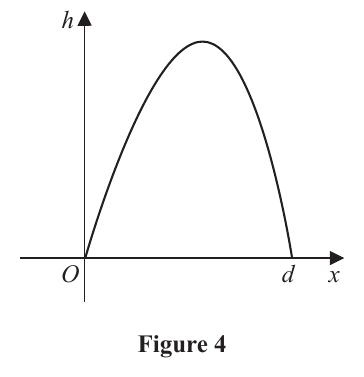
Figure 4 is a graph showing the path of a golf ball after the ball has been hit until it first hits the ground.
The vertical height, metres, of the ball above the ground has been plotted against the horizontal distance travelled, metres, measured from where the ball was hit.
The ball travels a horizontal distance of metres before it first hits the ground.
The ball is modelled as a particle travelling in a vertical plane above horizontal ground.
The path of the ball is modelled by the equation
Use the model to answer parts (a), (b) and (c).
(a) Find the value of , giving your answer to 2 decimal places.
(Solutions relying entirely on calculator technology are not acceptable.)
(b) Show that the maximum value of occurs when
Using the iteration formula
(c) (i) find the value of to 2 decimal places,
(ii) find, by repeated iteration, the horizontal distance travelled by the golf ball before it reaches its maximum height. Give your answer to 2 decimal places.
题目中文翻译
图 4 给出了高尔夫球从被击出到第一次落地之间路径的图像。
球离地面的竖直高度为 米,已绘制成关于水平距离 米的图像,其中 从球被击出的地点开始测量。
球在第一次落地前一共飞行了 米的水平距离。
将球视为在水平地面上方竖直平面内运动的质点。
球的路径模型方程为
使用该模型回答 (a)、(b) 和 (c)。
(a) 求 的值,答案精确到小数点后 2 位。
(不接受依赖计算器技术的解法。)
(b) 证明 的最大值出现在
时。
利用迭代公式
(c) (i) 求 的值,答案精确到小数点后 2 位;
(ii) 用重复迭代求高尔夫球到达最大高度前所飞行的水平距离,答案精确到小数点后 2 位。
解答
(a)
解法一
思路
展开
球第一次落地时 ,而对应的水平距离 。代入后提出并约去因子 ,再使用自然对数解指数方程;这样完整展示代数过程,而不是只依赖计算器求根。
答题过程
展开
When the ball first reaches the ground, and . Hence
Since , division by gives
Taking natural logarithms,
Therefore, to decimal places,
(b)
解法一
思路
展开
对 关于 求导,其中 要使用乘积法则。最大高度出现在区间内部的驻点,因此令导数为零,并逐步整理成题目要求的迭代形式。
答题过程
展开
Differentiating using the product rule,
At a stationary point,
Therefore,
Taking natural logarithms,
Also,
for . Hence this stationary point is a maximum, as required.
(c)(i)
解法一
思路
展开
将初值 代入题目给出的迭代公式,直接计算下一项。
答题过程
展开
Using ,
Therefore, to decimal places,
(c)(ii)
解法一
思路
展开
继续重复使用迭代公式。数列在极限值两侧交替靠近,因此应继续计算,直到相邻项都稳定地舍入为相同的两位小数。
答题过程
展开
Repeated iteration gives
\begin{array}{c|c@{\qquad}c|c} n & x_n & n & x_n \\ \hline 1 & 30.000000 & 11 & 30.874910 \\ 2 & 31.430433 & 12 & 30.886583 \\ 3 & 30.544311 & 13 & 30.879367 \\ 4 & 31.091391 & 14 & 30.883828 \\ 5 & 30.752925 & 15 & 30.881070 \\ 6 & 30.962056 & 16 & 30.882775 \\ 7 & 30.832735 & 17 & 30.881721 \\ 8 & 30.912664 & 18 & 30.882372 \\ 9 & 30.863247 & 19 & 30.881969 \\ 10 & 30.893794 & 20 & 30.882218 \end{array}The iteration converges to
Therefore, the horizontal distance travelled before the ball reaches its maximum height is