题目
Problem
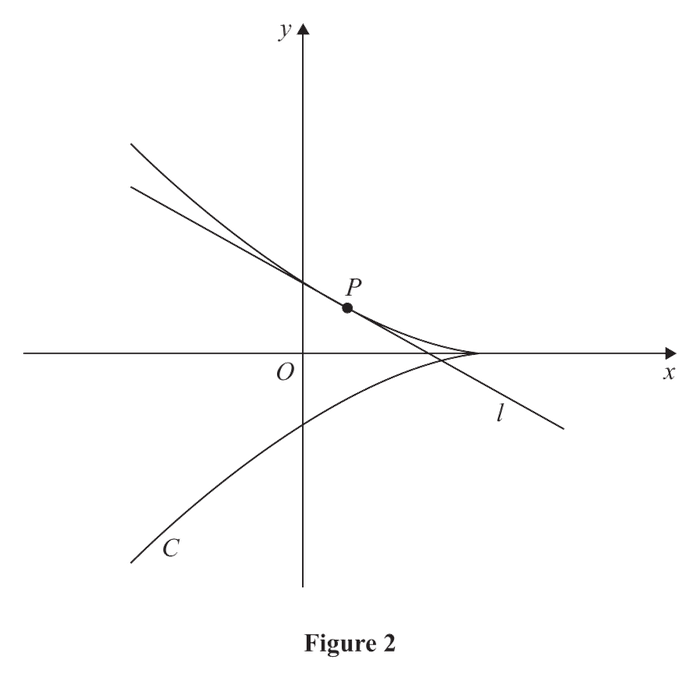
In this question you must show all stages of your working.
Solutions relying entirely on calculator technology are not acceptable.
Figure 2 shows a sketch of the curve C with parametric equations
x=2cos2ty=sin3t−2π<t<2π
where t is a parameter.
The point P lies on C where t=6π.
The line l, shown in Figure 2, is the tangent to C at P.
(a) Use parametric differentiation to show that
(i) dxdy=ksint where k is a constant to be found
(ii) an equation for l is 3x+16y−5=0
(6)
The line l intersects the curve C again at the point Q.
(b) Using algebra and showing detailed reasoning, find the exact coordinates of Q.
(6)
题目中文翻译
本题必须写出全部解题步骤。
不接受完全依赖计算器技术的解法。
图 2 给出了曲线 C 的草图,其参数方程为
x=2cos2ty=sin3t−2π<t<2π
其中 t 为参数。
点 P 在曲线 C 上,且 t=6π。
图 2 中的直线 l 是曲线 C 在点 P 处的切线。
(a) 用参数求导证明:
(i) dxdy=ksint,其中 k 是待求常数;
(ii) 直线 l 的一个方程为 3x+16y−5=0。
直线 l 再次与曲线 C 交于点 Q。
(b) 用代数方法并写出详细推理,求点 Q 的精确坐标。
解答
(a)(i)
We are given
x=2cos2t,y=sin3t
Differentiate with respect to t:
dtdx=−4sin2t
and
dtdy=3sin2tcost
Therefore
dxdy=dtdxdtdy=−4sin2t3sin2tcost
Using
sin2t=2sintcost
we get
dxdy=−8sintcost3sin2tcost
Hence
dxdy=−83sint
So
k=−83
(a)(ii)
At P,
t=6π
So
x=2cos3π=1
and
y=sin36π=(21)3=81
Therefore
P=(1,81)
The gradient of the tangent at P is
dxdy=−83sin6π=−83⋅21=−163
Using the point-gradient form,
y−81=−163(x−1)
Multiply by 16:
16y−2=−3x+3
Hence
3x+16y−5=0
as required.
(b)
At an intersection of the line l and the curve C,
3x+16y−5=0
Substitute
x=2cos2t,y=sin3t
to get
3(2cos2t)+16sin3t−5=0
So
6cos2t+16sin3t−5=0
Use
cos2t=1−2sin2t
Then
6(1−2sin2t)+16sin3t−5=0
So
16sin3t−12sin2t+1=0
Let
u=sint
Then
16u3−12u2+1=0
Since P corresponds to u=21, factor out 2u−1:
16u3−12u2+1=(2u−1)(8u2−2u−1)
Now
8u2−2u−1=(4u+1)(2u−1)
Therefore
16u3−12u2+1=(2u−1)2(4u+1)
For the second intersection Q,
4u+1=0
so
sint=−41
Now
y=sin3t=(−41)3=−641
Also,
cos2t=1−2sin2t=1−2(161)=87
Thus
x=2cos2t=2⋅87=47
Therefore
Q=(47,−641)