
题目
A certain disease occurs in a population in 2 mutually exclusive types.
A test has been developed to help diagnose whether or not a person has the disease. The event represents a positive result on the test. After a large-scale trial of the test, the following information was obtained.
For a person with type B of the disease the probability of a positive test result is 0.96
For a person who does not have the disease the probability of a positive test result is 0.05
For a person with type A of the disease the probability of a positive test result is
It is difficult to diagnose people with type A of the disease and there is an unknown proportion of the population with type A.
It is easier to diagnose people with type B of the disease and it is known that 2% of the population have type B.
(a) Complete the tree diagram.
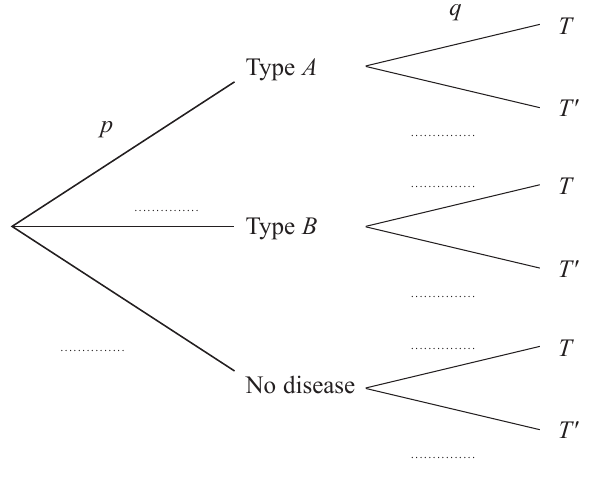
The probability of a randomly selected person having a positive test result is 0.169
For a person with a positive test result, the probability that they do not have the disease is
(b) Find the value of and the value of .
A doctor is about to see a person who she knows does not have type B of the disease but does have a positive test result.
(c) (i) Find the probability that this person has type A of the disease.
(ii) State, giving a reason, whether or not the doctor will find the test useful.
解答
(a)
解法一
思路
展开
第一层是 type A、type B、no disease,所以概率分别是 、0.02、。第二层每对分支相加为 1。
答题过程
展开
The first branches are
The second branches are
for type A,
for type B, and
for no disease.
(b)
解法一
思路
展开
先用 建立一个含 的方程。再用“positive 且 no disease”的条件概率求 ,最后代回求 。
答题过程
展开
Using ,
So
Hence
Also,
Therefore
Since ,
So
and
Substitute into :
Thus
so
(c)
解法一
思路
展开
已知不是 type B 且 positive,所以分母只包括 type A positive 与 no disease positive。分子是 type A positive。
答题过程
展开
We need
The numerator is
The denominator is
Therefore
So the probability is
The doctor will find the test useful because the probability of type A is now much higher than the original population probability .