题目
Problem
In the Venn diagram below, A, B and C are events and p, q, r and s are probabilities.
The events A and C are independent and P(A)=0.65
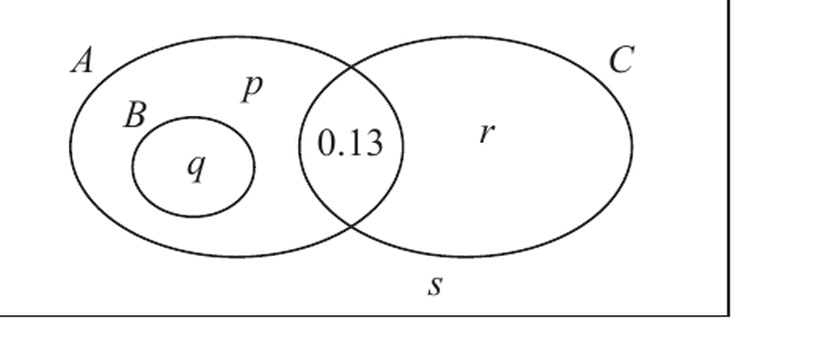
(a) State which two of the events A, B and C are mutually exclusive.
(1)
(b) Find the value of r and the value of s.
(5)
The events (A∩C′) and (B∪C) are also independent.
(c) Find the exact value of p and the exact value of q. Give your answers as fractions.
(6)
解答
(a)
解法一
思路
展开
互斥表示两个事件没有重叠区域。从图中看,B 和 C 没有共同部分。
答题过程
展开
B and C are mutually exclusive.
(b)
解法一
思路
展开
图中 A∩C 的概率是 0.13。由于 A 和 C 独立,P(A∩C)=P(A)P(C),可以先求出 P(C),再求 r。最后用全部概率加起来等于 1 求 s。
答题过程
展开
Since A and C are independent,
P(A∩C)=P(A)P(C).
Hence
0.13=0.65P(C),
so
P(C)=0.650.13=0.2.
From the diagram,
P(C)=r+0.13,
so
r=0.2−0.13=0.07.
Also,
P(A)+r+s=1.
Therefore
0.65+0.07+s=1,
and
s=0.28.
(c)
解法一
思路
展开
先把两个独立事件的概率写出来。A∩C′ 就是 A 中不在 C 的部分,即 p+q。由于 P(A)=0.65,而 A∩C=0.13,所以 p+q=0.52。然后用独立性建立方程。
答题过程
展开
Since
P(A)=p+q+0.13=0.65,
we have
p+q=0.52.
Also,
P(B∪C)=q+r+0.13=q+0.07+0.13=q+0.2.
The intersection of (A∩C′) and (B∪C) is the region q, so
P((A∩C′)∩(B∪C))=q.
Using independence,
P(A∩C′)P(B∪C)=q.
Therefore
0.52(q+0.2)=q.
So
0.52q+0.104=q,
and
0.48q=0.104.
Hence
q=0.480.104=6013.
Since p+q=0.52=2513,
p=2513−6013=300156−30065=30091.