题目
Problem
A factory produces shoes.
A quality control inspector at the factory checks a sample of 120 shoes for each of three types of defect. The Venn diagram represents the inspector’s results.
A represents the event that a shoe has defective stitching
B represents the event that a shoe has defective colouring
C represents the event that a shoe has defective soles
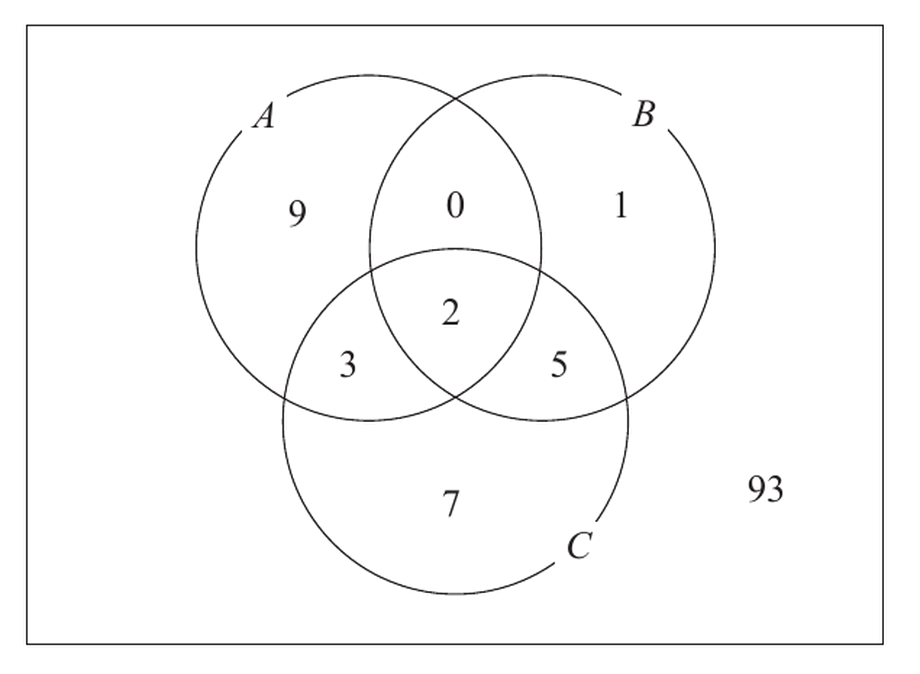
Venn diagram
One of the shoes in the sample is selected at random.
(a) Find the probability that it does not have defective soles.
(1)
(b) Find P(A∩B∩C′)
(1)
(c) Find P(A∪B∪C′)
(2)
(d) Find the probability that the shoe has at most one type of defect.
(2)
(e) Given the selected shoe has at most one type of defect, find the probability it has defective stitching.
(2)
The random variable X is the number of the events A, B, C that occur for a randomly selected shoe.
(f) Find E(X)
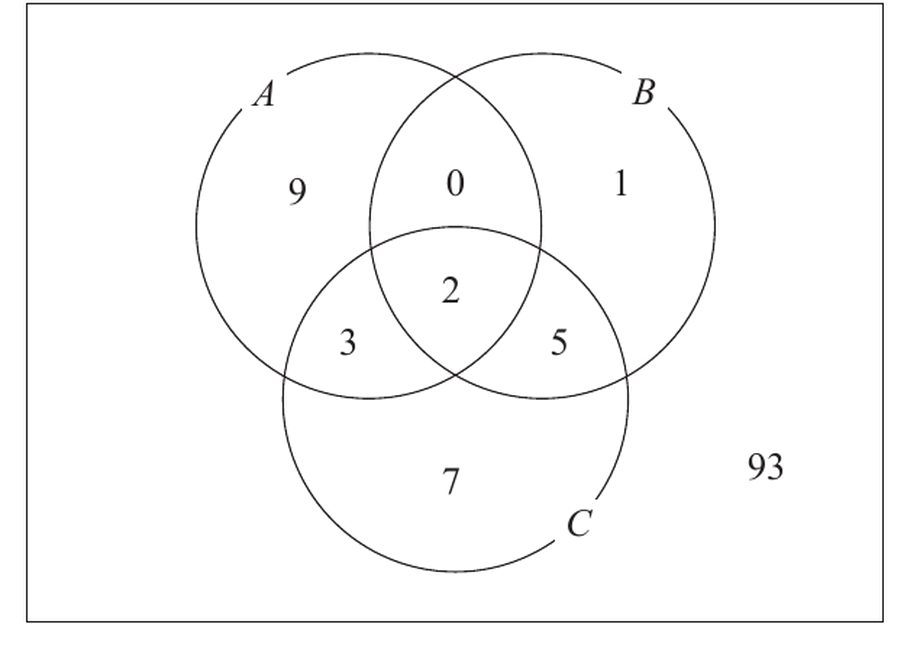
Copy of the Venn diagram
(3)
解答
(a)
解法一
思路
展开
不在 C 中的鞋共有 103 只,总数是 120。
答题过程
展开
P(C′)=120103.
(b)
解法一
思路
展开
A∩B∩C′ 是 A 和 B 的重叠但不在 C 中的区域,图中该区域为 0。
答题过程
展开
P(A∩B∩C′)=0.
(c)
解法一
思路
展开
A∪B∪C′ 的补集是 A′∩B′∩C,也就是只在 C 中的 7 只鞋。
答题过程
展开
P(A∪B∪C′)==1−1207120113.
(d)
解法一
思路
展开
“至多一种 defect” 包含没有 defect 和恰好一种 defect 的区域。
答题过程
展开
P(at most one type of defect)===12093+9+1+71201101211.
(e)
解法一
思路
展开
已知至多一种 defect。若还要有 defective stitching,只能落在只属于 A 的区域。
答题过程
展开
P(A∣at most one defect)==12011012091109.
(f)
解法一
思路
展开
先按发生的 defect 数量分组:X=0,1,2,3,再求期望。
答题过程
展开
From the Venn diagram,
xP(X=x)0120931120172120831202
Therefore
E(X)===0⋅12093+1⋅12017+2⋅1208+3⋅1202120394013.
解法二
思路
展开
期望的线性性质(指示随机变量法)。
我们可以将随机变量 X(每个鞋的缺陷数)拆分为三个指示随机变量之和:X=IA+IB+IC。其中 IA 表示是否发生缺陷 A(发生为 1,不发生为 0),以此类推。
由期望的线性性质,有:
E(X)=E(IA)+E(IB)+E(IC)=P(A)+P(B)+P(C)
这意味着,我们不需要列出完整的 X 概率分布表,只需统计所有缺陷的总次数(每个缺陷各算一次),再除以总样本量 120 即可:
E(X)=120n(A)+n(B)+n(C)
由于每个具有 x 个缺陷的鞋在 n(A)+n(B)+n(C) 中被重复计算了 x 次,因此总缺陷数直接等于:
1×n(X=1)+2×n(X=2)+3×n(X=3)
这大大简化了思维和代数过程。
答题过程
展开
Let IA,IB,IC be the indicator random variables for the events A,B,C respectively.
The total number of defects for a shoe is X=IA+IB+IC.
By the linearity of expectation:
E(X)===E(IA)+E(IB)+E(IC)P(A)+P(B)+P(C)120n(A)+n(B)+n(C).
Each shoe with x defects contributes x to the sum of n(A)+n(B)+n(C).
From the Venn diagram, we have:
- Number of shoes with 1 defect: n(X=1)=9+1+7=17
- Number of shoes with 2 defects: n(X=2)=8
- Number of shoes with 3 defects: n(X=3)=2
Thus, the total number of defects is:
n(A)+n(B)+n(C)====1×n(X=1)+2×n(X=2)+3×n(X=3)1(17)+2(8)+3(2)17+16+639.
Therefore:
E(X)==120394013.