题目
Problem
A box contains only red counters and black counters.
There are n red counters and n+1 black counters.
Two counters are selected at random, one at a time without replacement, from the box.
(a) Complete the tree diagram for this information.
Give your probabilities in terms of n where necessary.
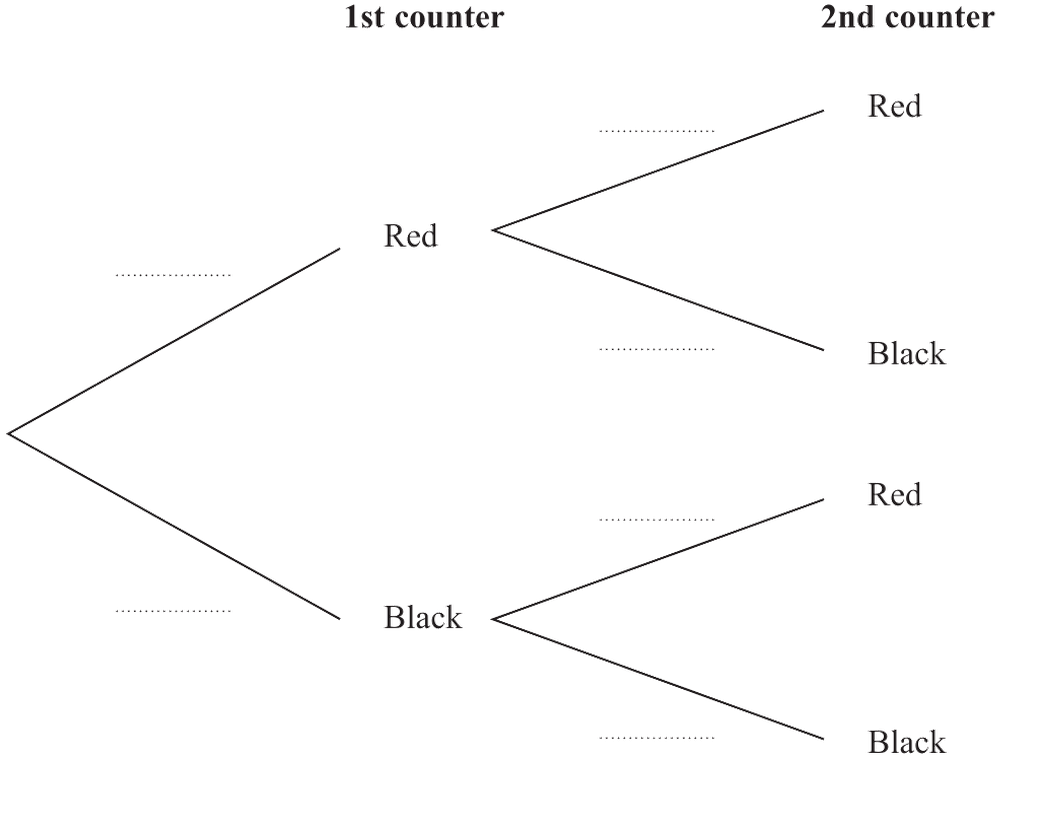
Tree diagram for two counters selected without replacement
(3)
(b) Show that the probability that the two counters selected are different colours is
2n+1n+1.
(2)
The probability that the two counters selected are different colours is 4925.
(c) Find the total number of counters in the box before any counters were selected.
(2)
Given that the two counters selected are different colours,
(d) find the probability that the 1st counter is black.
You must show your working.
(2)
解答
(a)
解法一
思路
展开
一开始共有
n+(n+1)=2n+1
个 counters。第一次抽完后,总数变成 2n,并且对应颜色数量会减少 1。
答题过程
展开
For the first counter,
P(R)=2n+1n,P(B)=2n+1n+1.
If the first counter is red, then there are n−1 red counters and n+1 black counters left, out of 2n counters.
So
P(R∣R)=2nn−1,P(B∣R)=2nn+1.
If the first counter is black, then there are n red counters and n black counters left, out of 2n counters.
So
P(R∣B)=2nn,P(B∣B)=2nn.
(b)
解法一
思路
展开
颜色不同有两种顺序:先红后黑,或先黑后红。分别沿树图相乘,再相加。
答题过程
展开
The counters are different colours if the outcomes are RB or BR.
Therefore
P(different colours)====2n+1n⋅2nn+1+2n+1n+1⋅2nn2n(2n+1)n(n+1)+n(n+1)2n(2n+1)2n(n+1)2n+1n+1.
(c)
解法一
思路
展开
把上一小题的表达式等于 4925,解出 n。题目问原来盒子中 counters 的总数,也就是 2n+1。
答题过程
展开
We have
2n+1n+1=4925.
Cross-multiplying,
49(n+1)=49n+49=n=25(2n+1)50n+2524.
The total number of counters is
2n+1=2(24)+1=49.
解法二
思路
展开
分式关系观察法(分子分母差值法)。我们观察方程:
2n+1n+1=4925
左边分式的分母与分子的关系满足:
分母−2×分子=(2n+1)−2(n+1)=−1
也就是说,分母刚好比分子的 2 倍少 1。
观察右边的已知分数 4925,其分母 49 也刚好比分子 25 的 2 倍少 1(即 2×25−1=49)。
因为 25 与 49 互质(没有公约数),该分数已是最简分数。
因此,我们可以直接令分子和分母分别对应相等:
n+1=25且2n+1=49
从而直接得出 n=24,并且原来盒子里的总数 2n+1 就是右边分数的分母 49。这种方法非常巧妙,体现了极佳的数感和比例逻辑。
答题过程
展开
Observe the algebraic structure of the equation:
2n+1n+1=4925.
Notice that the denominator on the left-hand side is related to the numerator by:
2(n+1)−(2n+1)=1.
On the right-hand side, the denominator and numerator satisfy the same relationship:
2(25)−49=1.
Since the fraction 4925 is in its simplest form, we can directly equate the corresponding numerators and denominators:
n+1=25⟹n=24
and the total number of counters is:
2n+1=49.
So the total number of counters is 49.
(d)
解法一
思路
展开
已知两次抽到不同颜色。要求“第一次是黑色”的条件概率,就是
P(different colours)P(BR).
代入 n=24 后算即可。
答题过程
展开
Using n=24,
P(BR)=4925⋅4824.
Also,
P(different colours)=4925.
Therefore
P(BR∣different colours)===49254925⋅4824482421.